



Thomas Rentsch
Senior Portfolio Manager High Yield
Credit default rates in high yield are falling and is the market underestimating this development?
A current analysis by Moody’s shows: Credit losses in the Ba, B and Caa rating categories are declining over time. In addition to better rating quality and lower duration, stricter regulation, greater transparency, active central bank interventions and more efficient restructuring have structurally changed the market environment.
What does this mean for investors and how robust is high yield really?
Credit default rates in high yield fall
When talking about the advantages of high-yield bonds, one hears arguments such as the increased proportion of BB bonds or the reduced duration.
However, Moody’s annual evaluation of default rates contains another interesting data series that shows falling credit losses over time in the Ba, B and Caa high-yield rating categories, thus providing a strong argument for the increased attractiveness of this credit segment.
Annual credit default rates by rating
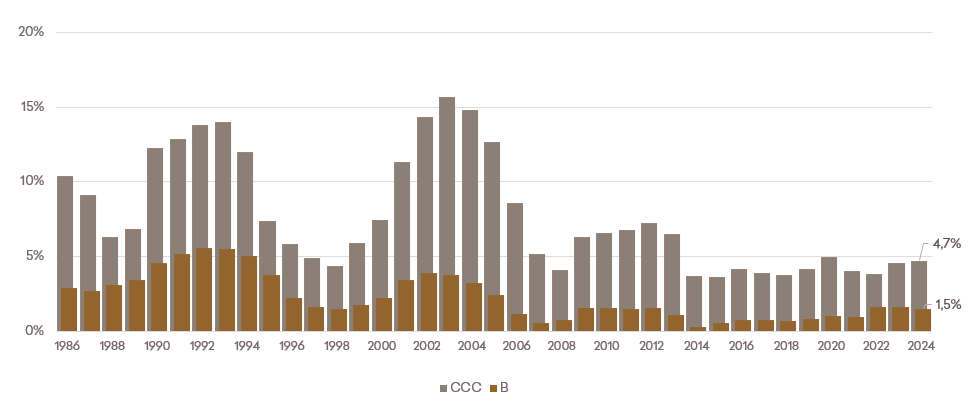
Source: Moody’s Annual default study, February 2025; credit default rate is the annual loss borne by investors as a combination of default rate and recovery rate
Increased regulation and transparency
With the expansion of regulatory requirements and improved transparency, the information basis for investors and analysts has fundamentally improved. Regulatory initiatives such as Basel II/III, stricter prospectus requirements and regular disclosure requirements have made it much easier for issuers and creditors to assess risks. The rating agencies analyze balance sheet quality, cash flow and management decisions more comprehensively than in the past. As a result, problematic issuers can be identified at an early stage, which leads to market participants reacting more quickly.
Influence of government and central bank interventions
A second important reason is the active role of governments and central banks in the economic cycle. Major recessions, which used to hit high yield particularly hard, are now cushioned by massive liquidity measures, corporate programs and bond purchases. Interest rate cuts and support measures prevent widespread waves of defaults following downturns. This can be seen impressively in the default statistics surrounding the crises of 2008 and 2020, where the rates fell again quickly despite economic shocks.
More efficient insolvency proceedings and out-of-court settlements
Last but not least, more efficient insolvency proceedings and the more frequent use of out-of-court settlements – such as “Amend & Extend” or distressed exchanges – have helped many issuers to overcome financial crises without having to file for formal insolvency. The ability to restructure existing debt or extend maturities enables companies and investors to limit losses and sustainably reduce default statistics.
Diversification of financing sources
In addition, companies no longer rely exclusively on bank loans or individual bond markets, but combine bonds, loans and private debt. This diversification reduces dependence on individual creditors and opens up alternative restructuring paths. This strengthens resilience – particularly in the high-yield segment – and helps to ensure that payment difficulties are less likely to result directly in defaults.
Significance for investors
High yield is more attractive to investors today than in the past: better ratings, falling default rates, stronger regulation, greater market transparency and low duration make the segment more robust. Nevertheless, active risk management remains essential and careful analysis and smart portfolio construction are still the key to sustainable investment success.
“When you talk about the advantages of high-yield bonds, you hear arguments such as the increased proportion of BB bonds or the reduced duration. However, that is no longer everything.”
– Thomas Rentsch
Risks
Price losses due to increases in yields and/or higher risk premiums are possible. A total loss cannot be ruled out.
Past performance is not an indication of future results, nor can future performance be guaranteed.
Disclaimer
This marketing communication within the meaning of the German Securities Trading Act is provided for information purposes only and should not be construed as personal investment advice or a recommendation or solicitation to buy, sell or hold any financial instrument or to adopt any investment strategy. The opinions and statements contained in this document reflect the current assessment at the date of publication. The information contained herein does not constitute a complete analysis of all material facts relating to any country, region or market. No financial analyses are prepared. Where statements are made about market developments, returns, price gains or other asset growth and risk figures, these are merely forecasts and we accept no liability for their occurrence. In particular, past performance, simulations or forecasts are not a reliable indicator of future performance. Assets can fall as well as rise. All information has been carefully compiled, in some cases with recourse to third-party information. Individual details may prove to be no longer or no longer fully accurate, in particular due to the passage of time, changes in the law or current market developments, and may change at any time without prior notice. No guarantee is therefore given for the correctness, completeness and topicality of all information. Please inform yourself independently about all costs relevant to you. Maintaining a custody account may incur costs; ongoing bank charges may also be incurred. Transaction costs depend on the asset class: For government bonds and collateralized bonds such as Pfandbriefe, they average around 0.02 percent, for corporate bonds 0.085 percent. For less liquid bonds, the transaction costs can also be significantly higher than 0.25 percent. It should also be noted that transaction costs can temporarily be significantly higher during periods of market stress. For all products sold by HAGIM, all relevant cost information is provided prior to purchase. The information is based on our assessment of the current legal and tax situation. Insofar as tax or legal matters are affected, these should be discussed by the addressee with its tax advisor or lawyer. Investments in financial instruments are associated with both opportunities and risks. The handling of conflicts of interest at HAGIM is published on the Internet at https://www.ha-gim.com/rechtlichehinweise. The information contained herein is intended for Professional Clients and Eligible Counterparties only. This information document is not intended for US citizens or persons permanently resident in the USA, nor for legal entities domiciled in the USA, nor may it be distributed in the USA