



Steffen Ullmann
Senior Portfolio Manager – Investment Grade
The recent escalation in the Middle East, particularly around Iran, has once again put the oil market in the spotlight – but for credit investors the really relevant question is a different one: Where is oil price risk even compensated for in credit? The answer is neither trivial nor intuitive – and has direct consequences for portfolio construction.
Oil price caught between geopolitical developments
The recent escalation in the Middle East – particularly around Iran – has once again put the oil market in the spotlight. Risks for production facilities, transport routes and the flow of oil through strategic straits dominate short-term pricing. At the same time, Venezuela remains a structurally relevant uncertainty factor on the supply side.
In such phases, energy credit is reflexively seen as a direct proxy for oil price risks. For credit investors, however, the crucial question is not whether oil prices are rising or falling – but where oil price exposure in credit is actually remunerated by an additional risk premium. This distinction is not a nuance, but the prerequisite for a clean and targeted credit allocation.
Our empirical analysis based on a 10-year period (March 2016 to March 2026) shows: The ability to manage oil price risk in credit does not primarily depend on the sector – but on the market segment.
EUR Investment Grade and High Yield: No reliable oil price channel
In the EUR investment grade segment, no statistically robust correlation between the oil price level and the additional credit risk premium for energy issuers can be demonstrated over the entire observation period. The excess spreads of EUR IG Energy show no systematic adjustment either at historically high or low oil prices.
The reason lies in the structure of the issuers themselves: Large, integrated oil companies absorb oil price fluctuations predominantly via equity mechanisms – flexible dividend policies, share buybacks or adjusted investment planning. Credit quality remains largely unaffected by this.
EUR IG Energy is therefore not a suitable instrument for allocating or managing oil price risks in credit.
Energy excess spread in EUR Credit
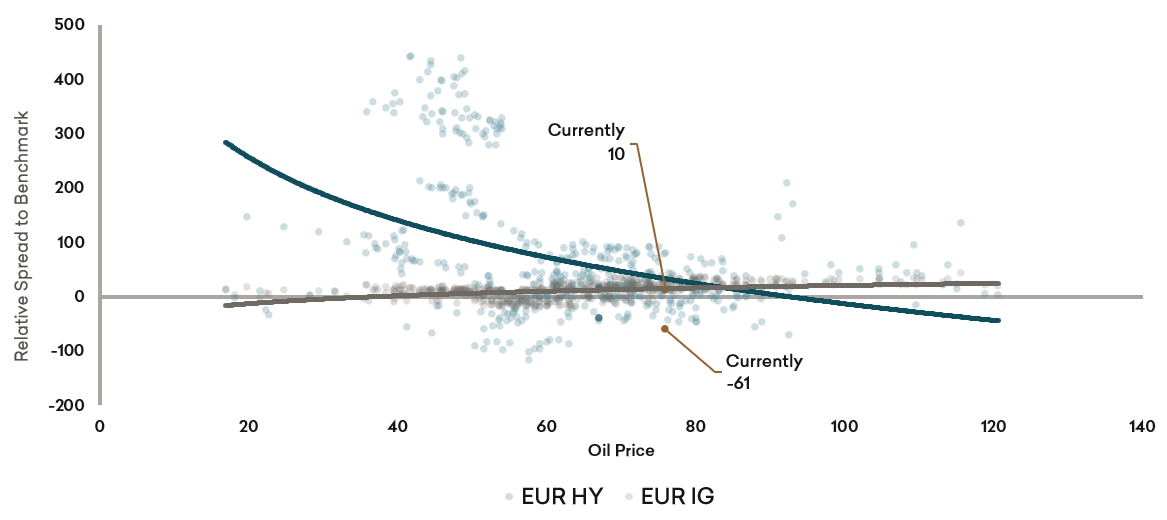
Source: Bloomberg; own calculations; period: 04.03.2016-04.03.2026. Definitions: EUR IG Energy Excess Spread = Euro Aggregate Energy Index (I03142 Index) relative to the Euro Aggregate Corporate ex Financials Index (LECFTREU Index); EUR HY Energy Excess Spread = Pan-European High Yield Energy Index (I05339EU Index) relative to the Pan-European High Yield Index (LP01Treu Index). Oil price: Generic 1st ‘CL’ Future (CL1 COMB Comdty). Own illustration.
Observation 2 – EUR High Yield Energy: Condition-based pricing
A more differentiated picture emerges in the EUR high yield segment. Historically, there has been no linear correlation between the oil price and the risk premium, but rather a convex “field hockey stick” structure:
As long as the oil price remains above around USD 55-60 per barrel, the additional credit risk premium for energy exposure remains limited and not very differentiated. Only below around USD 50, i.e. in periods of pronounced stress, do both the spread level and the dispersion between issuers increase noticeably.
Oil price risks are therefore not continuously remunerated in the EUR HY Energy segment, but rather depending on the situation. This reflects the high heterogeneity of the segment: oil price shocks are reflected selectively and with a delay in individual issuer profiles, making it difficult to systematically manage oil price exposures.
Emerging Markets Energy: Structurally and consistently priced
The picture in the emerging markets segment is very different. Here, there is a robust, approximately linear relationship between the oil price level and the additional credit risk premium for energy exposure – across the entire price spectrum, without being tied to a single critical threshold.
As the oil price falls, both the spread level and the range of excess spreads in the EM energy segment increase significantly. The effect is consistent and applies to both investment grade and high yield issuers from the EM universe.
The structural difference can be explained by the business models: many EM Energy issuers are upstream-oriented – their cash flows are more directly and immediately dependent on the oil price than the cash flows of integrated groups. State or quasi-state issuers from traditional producing countries further increase this sensitivity, as oil revenues have a direct impact on fiscal capacity and therefore creditworthiness.
Energy excess spread in EM Credit
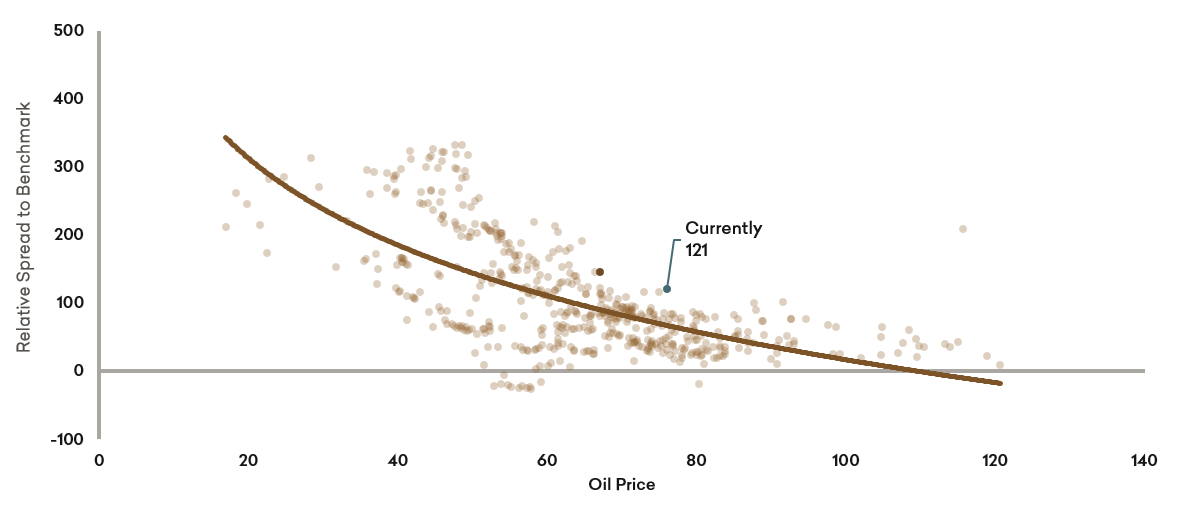
Source: Bloomberg; own calculations; period: 04.03.2016-04.03.2026. Definitions: EM Energy Excess Spread = EM USD Aggregate Energy Index (I29051US Index) relative to the EM USD Aggregate Index (EMUSTRUU Index). Oil price: Generic 1st ‘CL’ Future (CL1 COMB Comdty). Own illustration.
Implications for credit allocation
Energy exposure is not the same as oil price exposure. Anyone who automatically manages oil price risks via a sectoral energy allocation is subject to a structural misunderstanding – at least if the focus is on EUR-denominated markets.
The empirical findings suggest three clear conclusions:
- EUR IG Energy: No controllable oil price channel. Oil price fluctuations are not consistently reflected in credit spreads. Suitable for defensive credit allocation, not for targeted oil price positioning.
- EUR HY Energy: Conditionally controllable, with restrictions. An oil price-relevant risk premium arises primarily in stress phases. Condition-dependent pricing makes predictability more difficult and limits its suitability as a targeted allocation instrument.
- EM Energy: Consistent, investable oil price risk. The robust linear relationship between oil price and spread level enables targeted management of the oil price exposure in the credit portfolio – across regions and ratings.
For institutional investors who want to either specifically take on oil price risks in credit or consciously reduce them, the EM Energy segment is the way to go. The segment selection, production vs. distribution, is actually the decisive allocation dimension – not the sectoral allocation.
“In credit, oil price risks can only be specifically managed where the market actually remunerates them – and that is not where you would first expect.”
– Steffen Ullmann
Risks
Price losses due to increases in yields and/or higher risk premiums are possible. A total loss cannot be ruled out either.
Past performance is not an indication of future results, nor can future performance be guaranteed.
Disclaimer
This marketing communication within the meaning of the German Securities Trading Act
(Wertpapierhandelsgesetz) is provided for information purposes only and should not be construed
as personal investment advice or a recommendation or solicitation to buy, sell or hold
any financial instrument or to adopt any investment strategy. The opinions and statements
contained in this document reflect the current assessment on the date of publication. This information does not constitute a complete analysis of all material facts relating to any country,
region or market. This is not to be considered as financial analysis.
If statements are made about market developments, returns, price gains or other asset
growth as well as risk ratios, these merely constitute forecasts for whose occurrence we assume
no liability. Past performance, simulations or forecasts in particular are not a reliable
indicator of future performance. Assets can go up as well as down. All information has been carefully compiled; partly with recourse to information from third parties.Individual details may prove to be no longer or no longer fully accurate, in particular as a result of the passage of time, changes in the law, current developments on the markets, possibly at short notice, and may change at any time without prior notice. Therefore, no guarantee is given that all the information is correct, complete and up to date.
Please inform yourself independently about all costs relevant to you. Maintaining a custody
account may incur costs; ongoing bank charges may also be incurred. Transaction costs depend
on the asset class: For government bonds and collateralised bonds such as mortgage
bonds, they average around 0.02 percent, for corporate bonds 0.085 percent. For less liquid
bonds, the transaction costs can also be significantly higher than 0.25 per cent. It should also
be noted that transaction costs can temporarily be significantly higher during periods of market
stress. For all products sold by HAGIM, all relevant cost information is made available
prior to purchase.
The information is based on our assessment of the current legal and tax situation. If tax or
legal matters are affected, these should be discussed by the addressee with their tax advisor
or lawyer. Investments in financial instruments are associated with both opportunities and
risks. The handling of conflicts of interest at HAGIM is published online in the legal notice on
https://www.ha-gim.com/en/legal-information. The information contained in this document
is intended for professional clients and eligible counterparties only. This information document
is not directed at US citizens or permanent residents, nor to legal entities domiciled in
the USA, nor may it be distributed in the US.