


Europäische Hochzinsanleihen: Stabile Kupons bilden die Grundlage für eine langfristige Wertentwicklung; ein aktives Management kann zusätzliche Chancen eröffnen.
The Power of the Coupon!
After highlighting in our last Spotlight how European high-yield bonds offer predictable returns thanks to high coupons and low duration, this article analyzes the importance of coupons.1
As the following chart shows, the coupon is the main driver of the long-term performance of the European high-yield market.2 The portion of performance that cannot be explained by coupons has only a minor impact on overall performance over the long term.
European High-Yield Bonds—It’s All About the Coupon!
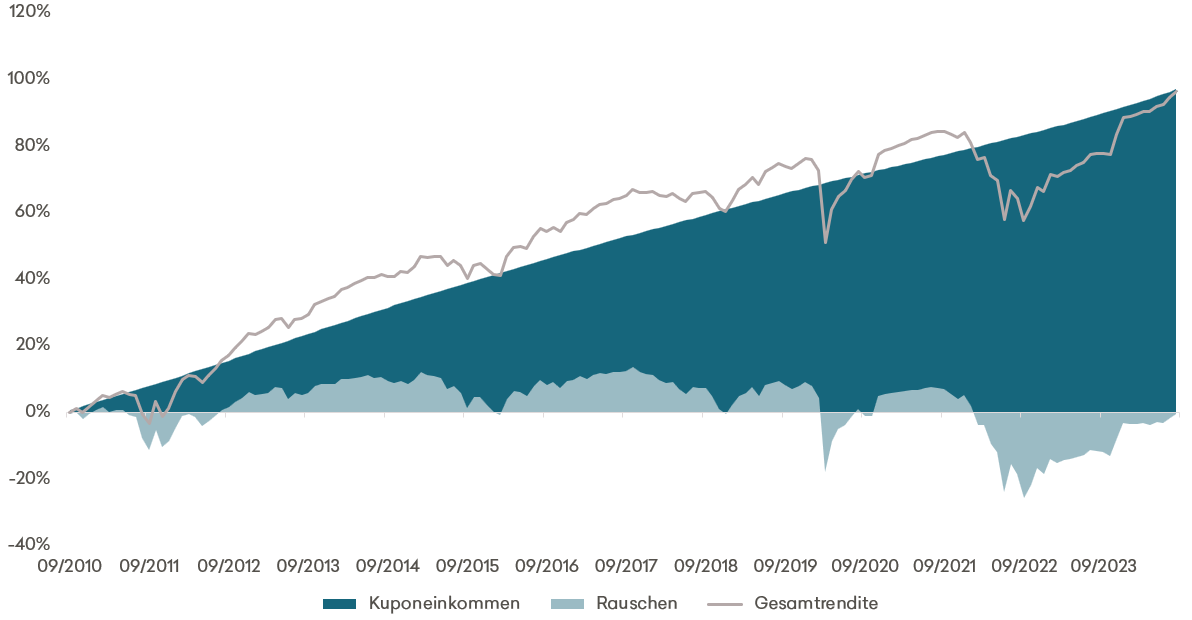
Source: Bloomberg, Bloomberg Euro High Yield ex Financials BB-B 3% Capped Total Return Index (H23969EU Index); “Noise” is the portion of the index’s total return not explained by coupon income
The effect of this “performance noise” fluctuates around zero over the long term, as the effects of changes in interest rates and spreads disappear relatively quickly due to the short duration of European high-yield bonds.3 Over the past 14 years, the overall impact of this noise has been Performance-neutral. However, there are occasional temporary deviations from the realized Performance of the coupon or market yield, which is driven by both market-specific and company-specific factors.
Positive Performance Noise
A general decline in interest rates or spreads leads to temporary excess returns in the market. However, these disappear relatively quickly due to the “pull-to-par” effect.
An individual bond may also experience a narrowing of its spread due to an improvement in the issuer’s credit quality, causing it to outperform its coupon or yield to maturity. This effect should also disappear due to the “pull-to-par” effect if the bond remains in the index until maturity. However, if the bond is upgraded to investment grade (Rising Star) following such outperformance due to credit improvement and exits the high-yield index, this effect will be permanently reflected in the high-yield benchmark performance.
Two other forms of positive noise, whose effects permanently boost index performance, are the roll-down effect and early redemptions: With the roll-down effect, a bond earns a higher yield in the early years than the coupon or yield to maturity promises, due to the declining redemption risk over time. This effect, which is actually temporary, becomes permanent because most bond indices exclude bonds with a remaining maturity of less than one year from the index. As a result, the final year of a bond—during which the yield falls below the coupon rate—is no longer included in the index.
Another scenario is the early redemption of a bond by the issuer. Since this generally occurs at prices above 100, the realized return will be permanently higher than the coupon or the yield to maturity.
Negative Performance Noise
If the general level of interest rates or spreads in the market rises, this leads to price declines and, consequently, temporary underperformance. However, due to the “pull-to-par” effect, these should disappear relatively quickly—at the latest by the end of the term.
A deterioration in an issuer’s credit quality and the resulting widening of its bond spreads will lead to underperformance relative to the coupon or yield to maturity. If the bond remains in the index, this underperformance will be only temporary due to the “pull-to-par” effect. However, in the event of downgrades—for example, to CCC—that result in exclusion from the index, or in the event of a default, the negative price loss will remain permanently in the benchmark performance.
The impact of negative performance noise on index performance generally outweighs other factors: Outperformance prior to an upgrade to the investment-grade benchmark is limited due to low duration, while price losses can be significant in the event of a credit downgrade and subsequent exclusion from the index or a direct default.
Conclusion – Perseverance Is the Key to Investment Success
Investors who can look past short-term performance fluctuations and focus on the coupons stand to do well as medium- and long-term investors in high-yield bonds (and other fixed-income asset classes)! Over holding periods of more than 5 years, European high-yield bonds have never posted a negative return; over 10 years, the historical return has been at least 3% per year; over 12 years, at least 4% per year; and over 20 years, at least 5% per year.

Source: Bloomberg, Bloomberg Euro High Yield ex Financials BB-B 3% Capped Total Return Index (H23969EU Index); annualized performance of the index across various starting year (beginning of each year) and holding period combinations
In addition, fundamental credit analysis can identify a deterioration in credit quality at an early stage and thereby prevent the potentially persistent negative performance noise resulting from credit quality deterioration in the portfolio.
For this reason, it is advisable to entrust investments in high-yield bonds to a proven fixed-income credit specialist. At HAGIM, we believe our investment philosophy—which is based on in-depth fundamental credit analysis—is ideally suited to meet such challenges, and we stand ready to assist you in designing investment solutions tailored to your needs.

Source: Bloomberg (Bloomberg Euro High Yield ex Financials BB-B 3% Capped Total Return Index, H23969EU Index)
1) “European High-Yield Bonds—Yields You Can Count On!” (September 2, 2024)
2) The chart can also be displayed using yield instead of coupon, since—given stable interest rates and risk premiums—it is actually the yield, not the coupon, that is earned; however, there are only minor differences in how this is presented in the chart.
3) Pull-to-Par Effect
Risks
Price losses due to increases in yields and/or higher risk premiums are possible. A total loss cannot be ruled out either. Past performance is not indicative of future results, nor can future performance be guaranteed.
Disclaimer
This marketing communication, as defined by the Securities Trading Act, is provided solely for informational purposes and should not be construed as personal investment advice, a recommendation, or a solicitation to buy, sell, or hold a financial instrument, or to adopt an investment strategy.
The opinions and statements contained in this document reflect the current assessment as of the date of publication. The information provided does not constitute a complete analysis of all material facts relating to a country, region, or market. No financial analyses are provided.
Any statements regarding market trends, returns, price gains, or other increases in asset value, as well as risk metrics, are merely forecasts, and we assume no liability for their realization. In particular, past performance, simulations, or forecasts are not a reliable indicator of future performance. Asset values may rise or fall. All information has been carefully compiled, in some cases based on information from third parties. Individual pieces of information may, in particular due to the passage of time, changes in the law, or current market developments, prove to be no longer accurate—or no longer fully accurate—even at short notice, and are subject to change at any time without prior notice. Therefore, no guarantee is provided as to the accuracy, completeness, or timeliness of any information.
Please research all costs relevant to you on your own. Maintaining a securities account may incur costs; in addition, ongoing bank fees may apply. Transaction costs depend on the asset class: For government bonds and secured bonds such as mortgage bonds, they average about 0.02 percent; for corporate bonds, 0.085 percent. For less liquid bonds, transaction costs can also be significantly higher than 0.25 percent. It should also be noted that transaction costs may temporarily be significantly higher during periods of market stress. For all products distributed by HAGIM, all relevant cost information is provided prior to purchase.
The information provided is based on our assessment of the current legal and tax situation. To the extent that tax or legal issues are involved, the recipient should discuss them with his or her tax advisor or attorney.
Investments in financial instruments involve both opportunities and risks. HAGIM’s policy on handling conflicts of interest is published online at https://www.ha-gim.com/rechtlichehinweise. The information contained herein is intended solely for professional clients or eligible counterparties. This information document is not intended for U.S. citizens, persons permanently residing in the United States, or legal entities domiciled in the United States, nor may it be distributed in the United States.