


Good News for Côte d’Ivoire’s Government Bonds?
The recent sharp rise in cocoa prices could prove to be a boon for Côte d’Ivoire’s government bonds. While other cocoa-producing countries, such as Ghana, are struggling with declining harvests, the positive price effects could more than offset the moderate decline in output in Côte d’Ivoire, strengthen the country’s current account balance in the long term, and have a positive impact on the risk premiums on its government bonds.The recent sharp rise in cocoa prices could prove to be a boon for Côte d’Ivoire’s government bonds. While other cocoa-producing countries such as Ghana are struggling with lower harvests, the positive price effects could more than offset the moderate decline in output in Côte d’Ivoire, strengthen the country’s current account balance in the long term, and have a positive impact on the risk premiums on its government bonds.
Background
The main reason for the price increase is supply shortages caused by unfavorable weather conditions and the spread of a viral disease specific to cocoa trees in major producing countries. It takes several years for newly planted cocoa trees to produce beans, so supply shortages cannot be resolved quickly.
Not Every Producer Benefits
While cocoa and cocoa products accounted for 28% of Côte d’Ivoire’s exports,[2] Ghana is a much more diversified exporting country. Cocoa and cocoa products accounted for only 9% of exports in 2022.[3]
In addition, Ghanaian cocoa producers fear a 40% decline in the upcoming harvest, while in Côte d’Ivoire, cocoa bean contract sales for the 2023/24 season are expected to be only 18% below the volume of the previous season.
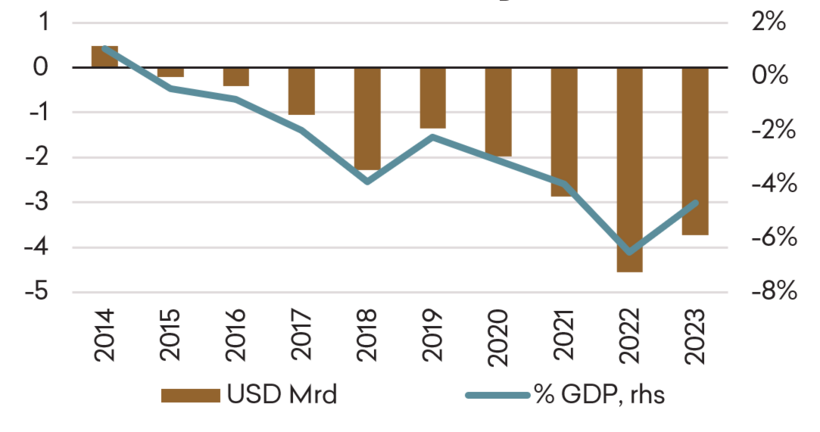
We expect that, for Côte d’Ivoire, the positive price effect will more than offset the decline in volume. The net effect should be reflected positively in Côte d’Ivoire’s current account balance, as the country has struggled with rising current account deficits in recent years.[4]
Euro High Yield Performance 2024
Côte d’Ivoire Current Account Balance
Conclusion:
[2] Source: Observatory of Economic Complexity OEC
[3] Source: Food and Agriculture Organization of the United Nations
[4]www.nasdaq.com/articles/ivory-coast-expects-20-drop-in-cocoa-production-in-2023-24-sources
Risks
Price losses due to rising yields and/or increased risk premiums are possible. Even a total loss cannot be ruled out. Past performance is not indicative of future results, nor can future performance be guaranteed.
Disclaimer
This marketing communication, as defined by the Securities Trading Act, is provided solely for informational purposes and should not be construed as personal investment advice, a recommendation, or a solicitation to buy, sell, or hold a financial instrument, or to adopt an investment strategy.
The opinions and statements contained in this document reflect the current assessment as of the date of publication. The information provided does not constitute a complete analysis of all material facts relating to a country, region, or market.
Any statements regarding market developments, returns, price gains, or other capital appreciation, as well as risk metrics, are merely forecasts for which we assume no liability. In particular, past performance, simulations, or forecasts are not a reliable indicator of future performance. Asset values may rise or fall.
All information has been carefully compiled, in some cases based on information from third parties. Individual pieces of information may, in particular due to the passage of time, changes in the law, or current market developments, prove to be no longer accurate—or no longer fully accurate—even at short notice, and may change at any time without prior notice.
Therefore, no warranty is provided as to the accuracy, completeness, or timeliness of any information. The information is based on our assessment of the current legal and tax situation. To the extent that tax or legal matters are addressed, the recipient should discuss these with their tax advisor or attorney.
Investments in financial instruments involve both opportunities and risks. HAGIM’s policy on handling conflicts of interest is published online at www.ha-gim.com/rechtliche-hinweiserechtliche-hinweise.
The information contained herein is intended solely for professional clients or eligible counterparties. This information document is not intended for U.S. citizens or persons permanently residing in the United States, nor may it be distributed in the United States.