



Steffen Ullmann
Senior Portfolio Manager Multi Asset Credit; Investment Grade
Portfolio Management Credit
Rather than geopolitical risks or growth concerns, another trend is currently shaping the credit markets: the growing divergence between government and corporate balance sheets. While many governments continue to increase their debt, companies are responding to higher financing costs with balance-sheet discipline and debt reduction.
In our view, it is precisely this distinction that explains why corporate credit remains remarkably stable despite a more challenging macroeconomic environment, and why risk premiums are trading near historic lows in many markets.
Corporate credit does not ignore the risks; it simply weights them differently. Governments are increasingly being penalized for lax fiscal policies and rising debt. Companies, on the other hand, are benefiting in many places from disciplined balance-sheet management and declining debt. Consequently, risk premiums in many credit segments remain near historic lows, even though long-term government bond yields, in particular, have recently come under pressure again.
A key reason for this lies in the market’s increasingly critical view of fiscal developments in many countries. There is a growing expectation that numerous governments are neither willing nor able to consolidate their budgets, and that public debt will continue to rise structurally.
Looking at the debt-to-asset ratios of governments and corporations (non-financials) in developed markets, the picture initially appears similar: Following the peaks reached during the pandemic, both sectors have reduced their debt. However, since the sharp rise in interest rates beginning in 2023, a clear divergence has become apparent. Companies continue to deleverage, while government debt is rising again (see Figure 1). Recent political developments and fiscal forecasts do not currently suggest a reversal of this trend.
Debt relief for companies. Not for countries.
Total debt of the private and public sectors, as a percentage of GDP
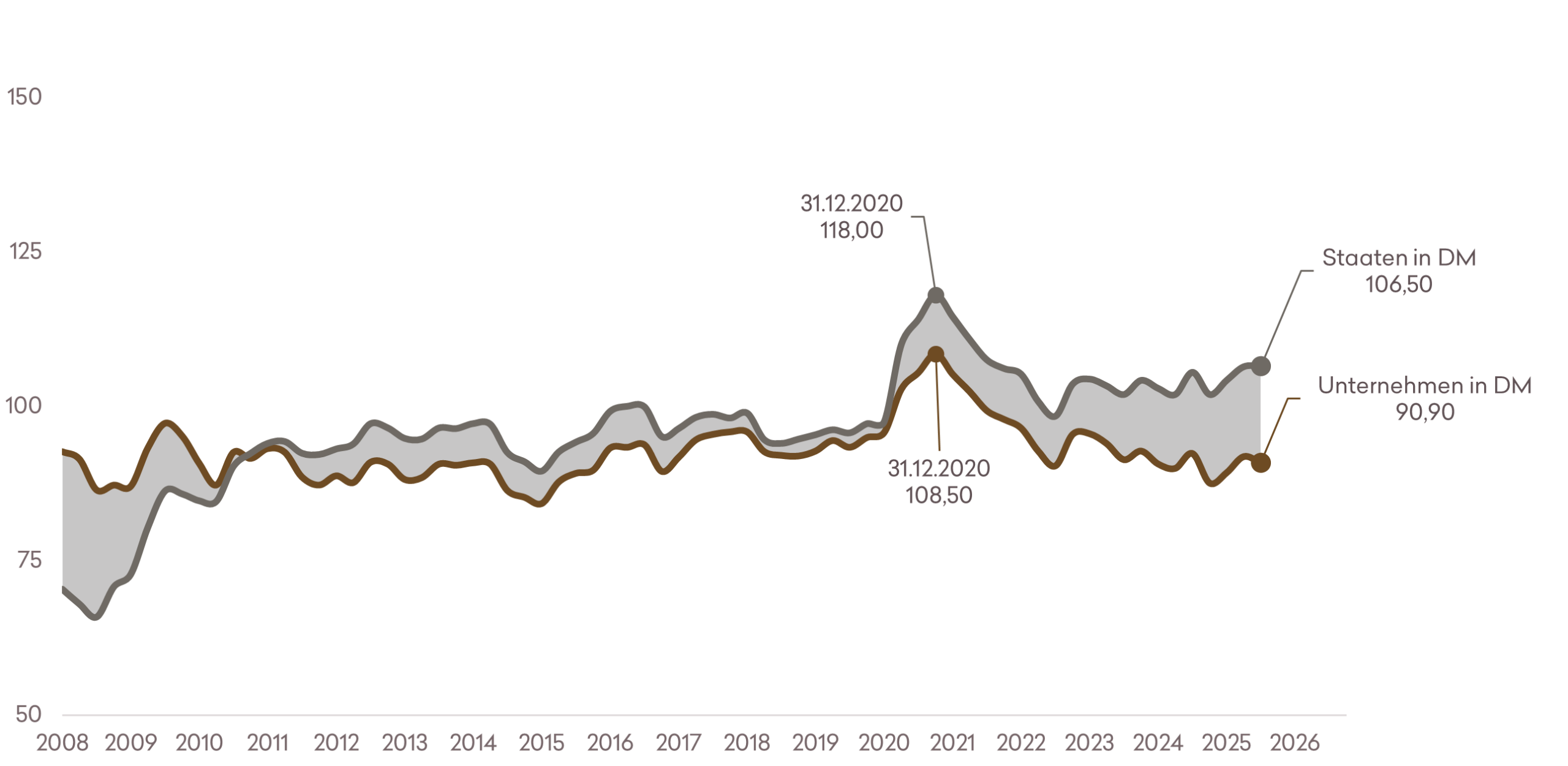
Source: Bloomberg, Bank for International Settlements; governments (BIS Advanced Economies Credit to General Government, Nominal, Adjusted for Breaks, % of GDP, CPNF5ROG Index) and corporations (BIS Advanced Economies Credit to Non-Financial Corporations, Adjusted for Breaks, % of GDP, CPNF5RNG Index); As of: March 31, 2008, through September 30, 2025.
The result: Investors are increasingly demanding a higher risk premium for government bonds, particularly at the long end of the yield curve.
The same pattern is evident in emerging markets as well, albeit in reverse. The private sector has traditionally had higher debt levels but has been gradually reducing them since 2020. Governments, on the other hand, continue to take on more debt. Same trend, different starting point.
Company debt relief. Countries do not.
Total debt of the private and public sectors, as a percentage of GDP
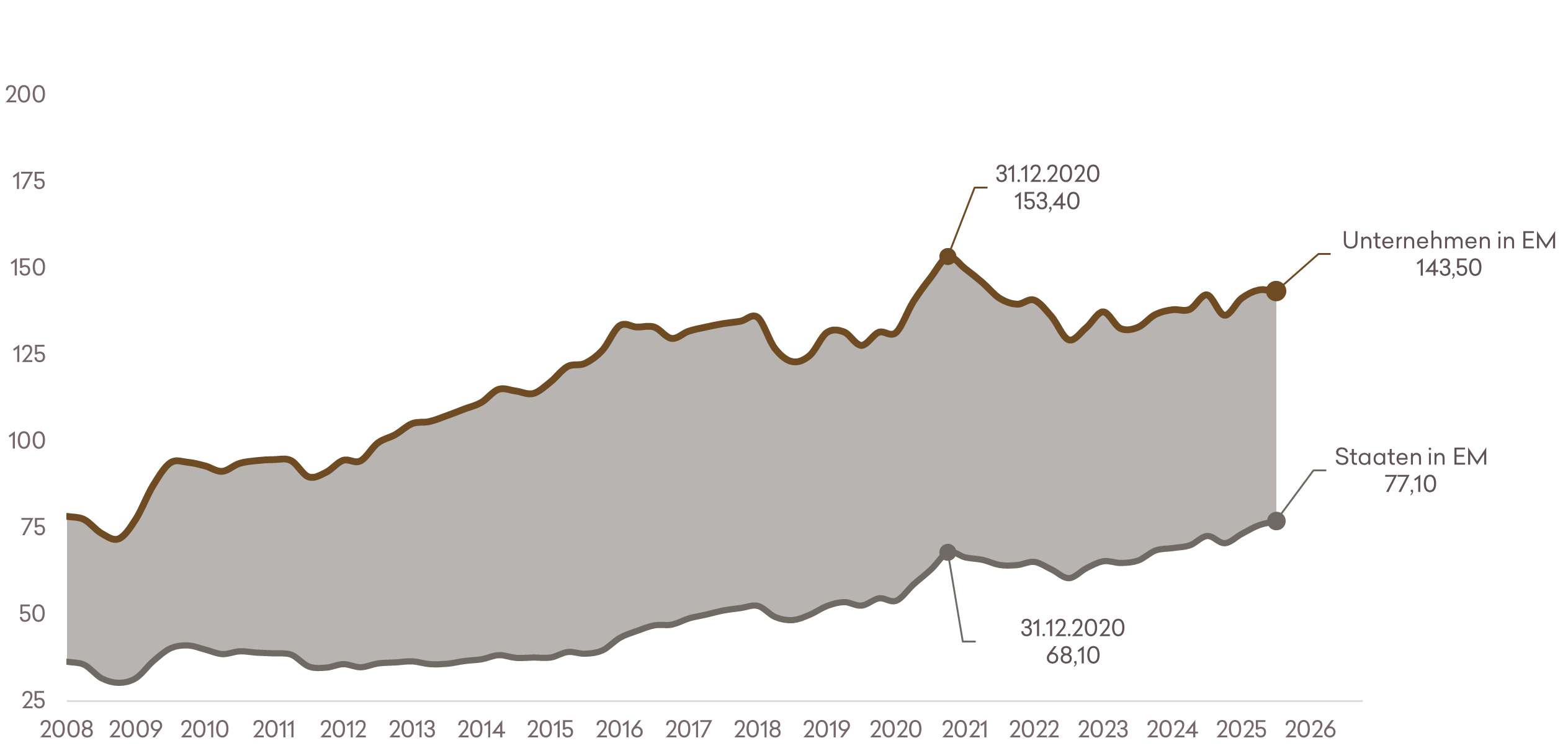
Source: Bloomberg, Bank for International Settlements; governments (BIS Emerging Economies Credit to General Government, Nominal, Adjusted for Breaks, % of GDP, CPNF4TOG Index) and corporations (BIS Emerging Economies Credit to Private Non-Financial Sector, Adjusted, % of GDP, CPNF4TPG Index); As of: March 31, 2008, through September 30, 2025.
In an environment of structurally higher financing costs, we favor issuers that use capital disciplinedly and actively strengthen their balance sheets. Accordingly, we remain constructive on corporate credit in developed and emerging markets.
As Bloomberg noted back in November: “Governments just carry on as usual—and nothing happens. Companies, on the other hand, have done their homework: They’ve reduced debt and remain disciplined in their spending.”¹
Sources:
¹ https://www.institional-money.com/news/maerkte/headline/bondmaerkte-kippen-warum-investoren-konzernen-mehr-trauen-als-staaten-246084
Risks
Price losses due to increases in yields and/or higher risk premiums are possible. A total loss cannot be ruled out either.
Past performance is not an indication of future results, nor can future performance be guaranteed.
Disclaimer
This marketing communication within the meaning of the German Securities Trading Act
(Wertpapierhandelsgesetz) is provided for information purposes only and should not be construed
as personal investment advice or a recommendation or solicitation to buy, sell or hold
any financial instrument or to adopt any investment strategy. The opinions and statements
contained in this document reflect the current assessment on the date of publication. This information does not constitute a complete analysis of all material facts relating to any country,
region or market. This is not to be considered as financial analysis.
If statements are made about market developments, returns, price gains or other asset
growth as well as risk ratios, these merely constitute forecasts for whose occurrence we assume
no liability. Past performance, simulations or forecasts in particular are not a reliable
indicator of future performance. Assets can go up as well as down. All information has been carefully compiled; partly with recourse to information from third parties.Individual details may prove to be no longer or no longer fully accurate, in particular as a result of the passage of time, changes in the law, current developments on the markets, possibly at short notice, and may change at any time without prior notice. Therefore, no guarantee is given that all the information is correct, complete and up to date.
Please inform yourself independently about all costs relevant to you. Maintaining a custody
account may incur costs; ongoing bank charges may also be incurred. Transaction costs depend
on the asset class: For government bonds and collateralised bonds such as mortgage
bonds, they average around 0.02 percent, for corporate bonds 0.085 percent. For less liquid
bonds, the transaction costs can also be significantly higher than 0.25 per cent. It should also
be noted that transaction costs can temporarily be significantly higher during periods of market
stress. For all products sold by HAGIM, all relevant cost information is made available
prior to purchase.
The information is based on our assessment of the current legal and tax situation. If tax or
legal matters are affected, these should be discussed by the addressee with their tax advisor
or lawyer. Investments in financial instruments are associated with both opportunities and
risks. The handling of conflicts of interest at HAGIM is published online in the legal notice on
https://www.ha-gim.com/en/legal-information. The information contained in this document
is intended for professional clients and eligible counterparties only. This information document
is not directed at US citizens or permanent residents, nor to legal entities domiciled in
the USA, nor may it be distributed in the US.