



Thomas Rentsch
Senior Portfolio Manager High Yield
High Yield: Strategisches Kerninvestment statt prozyklischer Nische
Over the past decade and a half, the European high-yield market has undergone a structural transformation that has rendered its traditional classification as a procyclical yield niche obsolete. Historically, the European high-yield bond asset class was used primarily as a tactical tool by pension funds, retirement plans, and insurance companies. It was mostly used to opportunistically capture yield premiums during periods of robust economic expansion. When macroeconomic risks intensified, a procyclical reallocation to supposedly safer asset classes occurred rapidly.
However, this binary approach no longer does justice to the structural maturity, fundamental quality, and demonstrable diversification benefits of the modern euro high-yield market in 2026. A detailed look at fundamental developments and historical return characteristics makes it clear that European high-yield bonds have long since not only met all the criteria for a sustainable strategic core investment but that a strategic investment in them also has a positive impact on the risk-return profile of the entire fixed-income allocation. Precisely because the macroeconomic environment remains fragile, the conceptual structuring of the portfolio is more important than the tactical timing.
Macroeconomic Resilience and Structural Market Readiness
The current economic environment presents investors with complex challenges. According to current forecasts by leading economic institutes, the eurozone is walking a fine line with only moderate growth of around one percent. This fragility is further exacerbated by geopolitical tensions and trade restrictions, while central banks are performing a difficult monetary policy balancing act. In such a scenario of stagnant growth and interest rate uncertainty, asset classes with high current yields and short-term fixed-rate periods offer the greatest strategic value. The European high-yield market currently yields just over 5.5 percent and, on this basis, has a break-even point of nearly 200 basis points. The market yield would have to rise by this amount within a year before the current interest income from the coupon is eroded and a negative total return is generated.¹ Based on the historical average since September 2006—a period encompassing the European sovereign debt crisis, the slowdown in Chinese growth in 2015–2016, the COVID-19 pandemic, and the European energy crisis; this break-even point stood at 168 basis points. The current level is thus above the long-term average.
¹ Bloomberg High Yield (Euro) ex Fin TR Index (I20672EU Index), Stand: 05.05.2026
Break-Even Point for High-Yield
A Financial Buffer Before Returns Are Eroded

Source: Bloomberg, own calculations; Bloomberg Pan-European High Yield Index (LP01TREU Index); as of: 2005 through April 2026.
The European high-yield bond market has evolved from a narrow niche into a deep and liquid core segment with an investable volume of well over 300 billion euros.² Driven by stricter banking regulations and the withdrawal of European commercial banks from traditional lending, large segments of the SME sector and large corporations have turned to the capital markets. This has led to enormous sector diversification. In contrast to the U.S. market, which is heavily dominated by the cyclical energy sector, the European market reflects the full breadth of the real economy and is therefore subject to significantly fewer commodity-related fluctuations. In addition, European issuers have taken advantage of the recent period of low interest rates to proactively restructure their balance sheets and extend maturities well into the future.
Current refinancing trends confirm this finding: Issuers of European high-yield bonds are increasingly proactively rolling over their debt before it reaches maturity—a practice that mitigates refinancing risks associated with the maturity profile before they become a burden. Assessing refinancing capacity at the individual security level is a central task of active credit selection and leads to a level of differentiation that market-weighted passive replication is structurally unable to achieve.
² Bloomberg High Yield (Euro) ex Fin TR Index (I20672EU Index)
Superior Credit Quality Structure and the Anatomy of Default Risks
Classifying an investment as a permanent core holding requires a precise analysis of the underlying credit quality. By far the most important structural advantage of the European market is its superior credit quality. In the Bloomberg High Yield (Euro) ex Fin TR Index, the proportion of bonds with a BB rating has remained stable at around 70% for over a decade—a structural, non-cyclical market characteristic that has endured across multiple credit cycles. This is the highest and safest tier within the speculative spectrum and stands in sharp contrast to the U.S. market, where significantly riskier securities account for a much larger share. Combined with an extremely short average duration of only about three years, the European high-yield market offers a natural hedge against unexpected interest rate hikes.³
Historically, the strongest argument against strategic allocation in this segment has been the fear of capital losses due to corporate insolvencies. However, the allocation decision of institutional investors is not determined by the nominal default rate, but rather by the risk-adjusted net return—that is, the current return minus the expected loss. The expected loss is derived from the probability of default and the loss ratio, with the loss ratio being directly determined by the recoverable amounts in the event of insolvency. A significant portion of the reported credit events in the European market stems from distressed exchanges, in which maturities are extended or coupons are adjusted — events that appear in nominal default statistics but are generally accompanied by significantly higher recoveries than traditional insolvencies involving liquidation. These scenarios are not risk-free: Unequal treatment of different creditor groups can generate significant differences in losses between individual tranches. This is precisely why creditor protection clauses, position in the capital structure, and the collateral structure are key selection criteria for active managers and determine the actual loss ratio realized. As a result, the risk premium of the European high-yield market is structurally above historically realized default rates—meaning that the risk premium not only compensates for the default risk but also yields a significant excess return compared to safer bond segments.
³ Duration as of the least favorable termination date of the Bloomberg High Yield (Euro) ex Fin TR Index (I20672EU Index)
Annual Credit Default Rates by Rating
From 1986 to the Present

Source: Bloomberg, own calculations; Bloomberg Pan-European High Yield Index (LP01TREU Index); as of: 2005 through April 2026.
Increasing Efficiency According to Modern Portfolio Theory: High-Yield Bonds Belong in the Strategic Fixed-Income Allocation
From the academic perspective of asset allocation, empirical data shows that the systematic inclusion of high-yield bonds (VAG-compliant) significantly improves a portfolio’s efficient frontier. Looking at the long economic cycle of the past twenty-five years, the systematic addition of just twenty percent high-yield bonds to a pure investment-grade portfolio noticeably increased the annualized total return. At the same time, the significantly shorter maturity of high-yield bonds drastically reduced the overall portfolio’s interest rate risk, while volatility increased only marginally. The resulting blended portfolio was thus significantly more efficient than the supposedly safer baseline.
High Yield as Part of Strategic Allocation
Risk-Return Profile of EUR Fixed Income: Strategic HY Allocation Pays Off
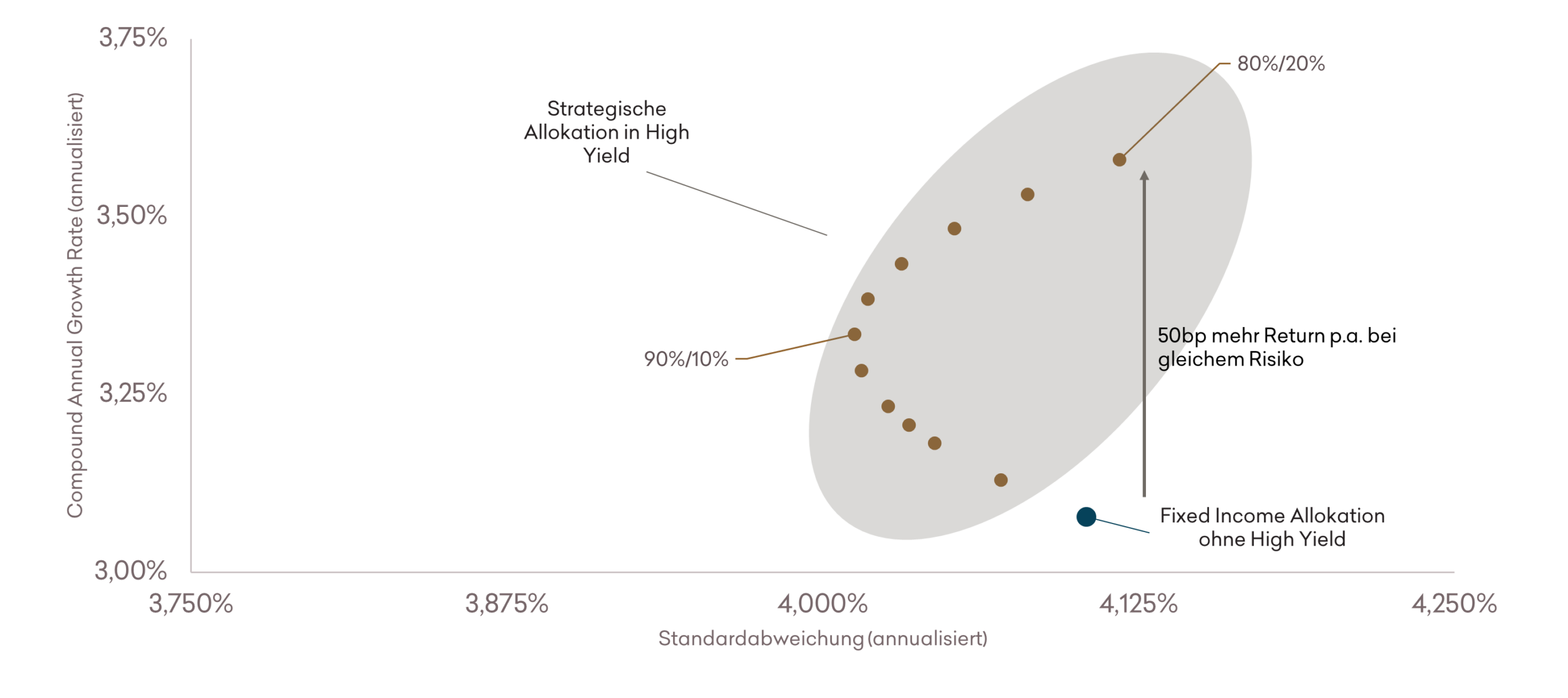
Source: Bloomberg; Bloomberg Euro Aggregate Bond Index (Total Return), Bloomberg Euro High Yield Corporate Bond Index ex CCC (Total Return); As of April 24, 2026. Methodology: Monthly index data; CAGR, volatility, and portfolio simulations based on our own calculations.
Furthermore, European high-yield bonds have consistently and systematically outperformed their U.S. counterparts for decades.⁴ This steady outperformance is the direct result of better structural credit quality, lower interest rate sensitivity, and more restrictive European bankruptcy laws. Investors who exclude Euro High Yield for purely dogmatic reasons force their portfolios into suboptimal niche areas and often have to overweight more volatile or illiquid asset classes to achieve their target returns.
A comprehensive risk analysis also requires consideration of market liquidity. The European high-yield market is deep during normal market conditions and sufficiently developed to accommodate institutional volumes. During periods of stress, such as in 2020 or 2022, liquidity may temporarily tighten, resulting in wider bid-ask spreads and reduced secondary market depth. Active liquidity management, disciplined cash management, and a deliberate avoidance of forced sales during periods of stress are therefore integral components of institutional management in this segment and a prerequisite for realizing the market’s carry benefits over full cycles.
⁴ Including the effect of currency hedging
Implications for Implementation
The key to success lies in selection: building exposure exclusively to bonds issued by issuers with a strong ability to repay, as assessed based on capital structure, cash flow quality, and covenant protection. Positions are established based on fundamental credit convictions, not on index alignment. And they are consistently reduced when credit quality deteriorates structurally—not only after the rating follows suit.
Added to this is significant price dispersion within the market: Bonds with identical credit ratings regularly trade at significantly different yields that cannot be consistently explained by fundamentals. For research-driven active managers, this dispersion is a key source of selection alpha. It allows them to capture risk premiums where they are not justified by below-average credit quality and to reduce exposure where the risk premium does not adequately compensate for the actual risk.
A market-weighted passive replication cannot structurally achieve this differentiation: It assigns the highest weightings to those issuers that have taken on the most debt—regardless of their credit quality. Active management, on the other hand, can consistently weed out underperformers and identify opportunities in market segments that have been unjustifiably penalized.
“Euro High Yield is no longer a tactical tool. It is a structural component of efficient institutional credit allocation.”
Thomas Rentsch, Lead High-Yield Portfolio Manager, HAGIM
HAGIM Webinar – High Yield:
A Core Strategic Investment Rather Than a Procyclical Niche

Risks
Price losses due to increases in yields and/or higher risk premiums are possible. A total loss cannot be ruled out.
Past performance is not an indication of future results, nor can future performance be guaranteed.
Disclaimer
This marketing communication within the meaning of the German Securities Trading Act is provided for information purposes only and should not be construed as personal investment advice or a recommendation or solicitation to buy, sell or hold any financial instrument or to adopt any investment strategy. The opinions and statements contained in this document reflect the current assessment at the date of publication. The information contained herein does not constitute a complete analysis of all material facts relating to any country, region or market. No financial analyses are prepared. Where statements are made about market developments, returns, price gains or other asset growth and risk figures, these are merely forecasts and we accept no liability for their occurrence. In particular, past performance, simulations or forecasts are not a reliable indicator of future performance. Assets can fall as well as rise. All information has been carefully compiled, in some cases with recourse to third-party information. Individual details may prove to be no longer or no longer fully accurate, in particular due to the passage of time, changes in the law or current market developments, and may change at any time without prior notice. No guarantee is therefore given for the correctness, completeness and topicality of all information. Please inform yourself independently about all costs relevant to you. Maintaining a custody account may incur costs; ongoing bank charges may also be incurred. Transaction costs depend on the asset class: For government bonds and collateralized bonds such as Pfandbriefe, they average around 0.02 percent, for corporate bonds 0.085 percent. For less liquid bonds, the transaction costs can also be significantly higher than 0.25 percent. It should also be noted that transaction costs can temporarily be significantly higher during periods of market stress. For all products sold by HAGIM, all relevant cost information is provided prior to purchase. The information is based on our assessment of the current legal and tax situation. Insofar as tax or legal matters are affected, these should be discussed by the addressee with its tax advisor or lawyer. Investments in financial instruments are associated with both opportunities and risks. The handling of conflicts of interest at HAGIM is published on the Internet at https://www.ha-gim.com/rechtlichehinweise. The information contained herein is intended for Professional Clients and Eligible Counterparties only. This information document is not intended for US citizens or persons permanently resident in the USA, nor for legal entities domiciled in the USA, nor may it be distributed in the USA