



Thomas Rentsch
Senior Portfolio Manager High Yield
Germany’s shift away from austerity—for example, through a 500-billion-euro infrastructure package and increased defense spending—has dampened hopes for falling interest rates. At the same time, Trump’s “Liberation Day” has shown just how quickly low risk premiums can come to an end.
This has led to a significant increase in new issuance activity for European high-yield bonds. However, the focus remains on bonds with medium maturities. From an investor’s perspective, this is a positive development, as it simultaneously reduces issuers’ default risk and aligns well with investors’ preferences for shorter- or medium-term investments.
European High-Yield Bonds: More New Issuances Despite Interest Rate Risks
In late February, we discussed how issuers in the European high-yield market were currently refraining from issuing long-term bonds [1]. The elevated interest rates at that time, coupled with expectations of falling rates, prompted many companies to avoid locking themselves into high interest rates for the long term.
However, this hope has cooled somewhat since early March. A key trigger for this shift in sentiment is Germany’s departure from its austerity policy. With the passage of a 500-billion-euro infrastructure package and a structural increase in defense spending, policymakers are signaling a willingness to take on new debt—a move that could potentially lead to rising interest rates. At the same time, Donald Trump, with his “Liberation Day” and the ensuing market turbulence, has shown just how quickly the era of low risk premiums can come to an end.
These developments make waiting for more attractive refinancing costs increasingly risky. It is therefore welcome news that issuers are increasingly actively seeking refinancing. As a result, new issuance activity has increased noticeably. This was interrupted only briefly by the volatility following “Liberation Day.” However, companies continue to focus on medium-term maturities (mostly 5 years, though some are 6- and 7-year maturities) in order to maintain the flexibility to refinance at more favorable terms in two or three years.
For investors, in turn, these new issuances offer the opportunity to acquire bonds with attractive coupons and limited duration. At the same time, this increase in refinancing activity is welcome from the investors’ perspective, as a reduction in short-term maturities significantly lowers the short- and medium-term default risk.
New Issuances in 2025 – Volume and Remaining Maturity by Calendar Week
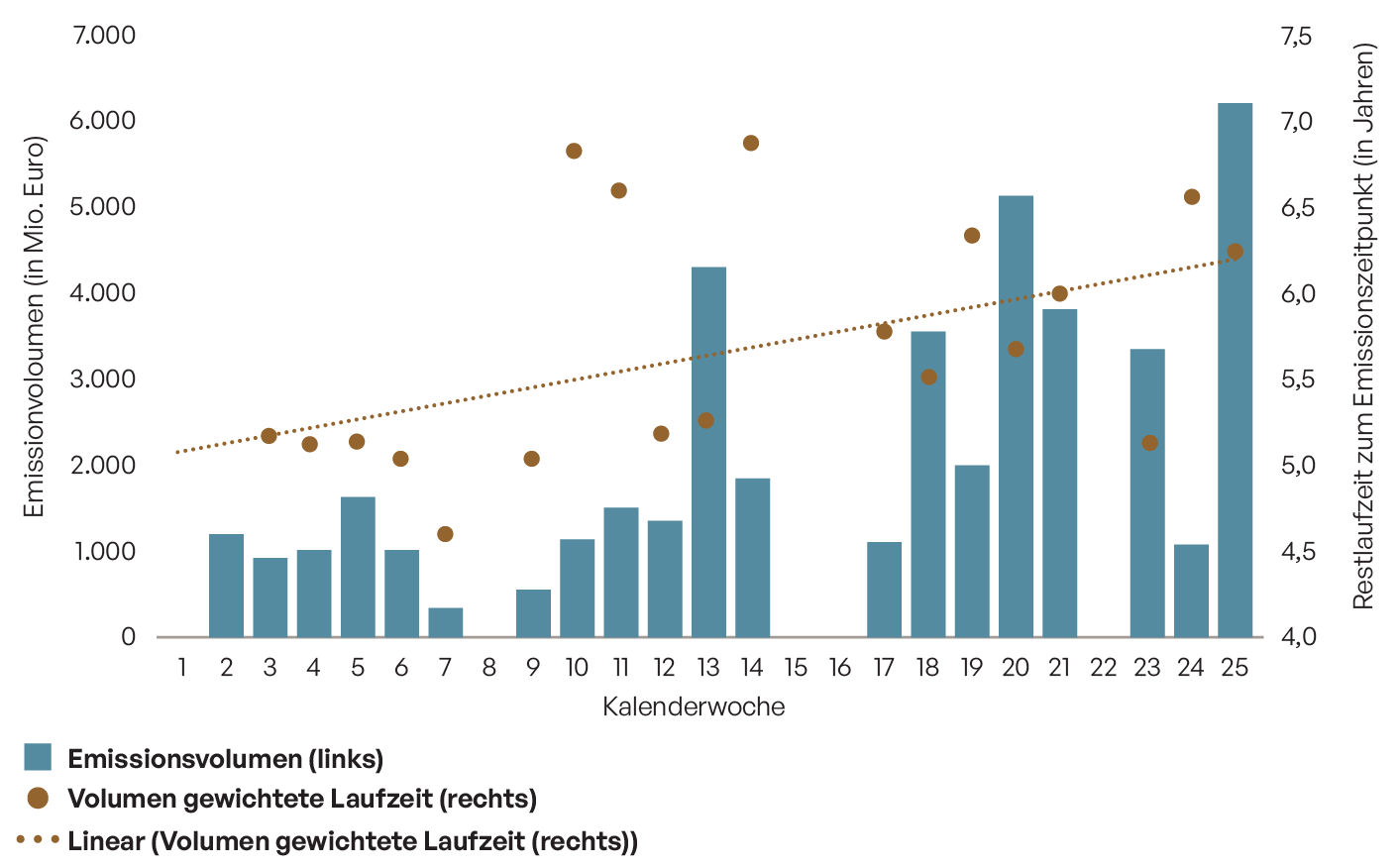
Source: Bloomberg Euro High Yield ex Financials BB-B 3% Capped Total Return Index (H23969EU Index), only bonds included in the index (excluding financial bonds and floating-rate bonds); for hybrid bonds, the first coupon reset date was used as the maturity date; January 1, 2025–June 20, 2025

Source: Bloomberg (Bloomberg Euro High Yield ex Financials BB-B 3% Capped Total Return Index, H23969EU Index)
“New issuance activity in the European high-yield bond market has increased significantly since March of this year, with the focus remaining on medium-term maturities, which are preferred by investors.”
– Thomas Rentsch
Senior Portfolio Manager – High Yield
[1] https://ha-gim.com/praeferenz-fuer-kurz-und-mittelfristige-finanzierungen-wird-die-wette-der-unternehmen-auf-niedrige-renditen-aufgehen/
Risks
Price losses due to rising yields and/or increased risk premiums are possible. A total loss cannot be ruled out either.
Past performance is not indicative of future results, nor can future performance be guaranteed.
Disclaimer
This marketing communication within the meaning of the German Securities Trading Act is provided for information purposes only and should not be construed as personal investment advice or a recommendation or solicitation to buy, sell or hold any financial instrument or to adopt any investment strategy. The opinions and statements contained in this document reflect the current assessment at the date of publication. The information contained herein does not constitute a complete analysis of all material facts relating to any country, region or market. No financial analyses are prepared. Where statements are made about market developments, returns, price gains or other asset growth and risk figures, these are merely forecasts and we accept no liability for their occurrence. In particular, past performance, simulations or forecasts are not a reliable indicator of future performance. Assets can fall as well as rise. All information has been carefully compiled, in some cases with recourse to third-party information. Individual details may prove to be no longer or no longer fully accurate, in particular due to the passage of time, changes in the law or current market developments, and may change at any time without prior notice. No guarantee is therefore given for the correctness, completeness and topicality of all information. Please inform yourself independently about all costs relevant to you. Maintaining a custody account may incur costs; ongoing bank charges may also be incurred. Transaction costs depend on the asset class: For government bonds and collateralized bonds such as Pfandbriefe, they average around 0.02 percent, for corporate bonds 0.085 percent. For less liquid bonds, the transaction costs can also be significantly higher than 0.25 percent. It should also be noted that transaction costs can temporarily be significantly higher during periods of market stress. For all products sold by HAGIM, all relevant cost information is provided prior to purchase. The information is based on our assessment of the current legal and tax situation. Insofar as tax or legal matters are affected, these should be discussed by the addressee with its tax advisor or lawyer. Investments in financial instruments are associated with both opportunities and risks. The handling of conflicts of interest at HAGIM is published on the Internet at https://www.ha-gim.com/rechtlichehinweise. The information contained herein is intended for Professional Clients and Eligible Counterparties only. This information document is not intended for US citizens or persons permanently resident in the USA, nor for legal entities domiciled in the USA, nor may it be distributed in the USA