


How have high-yield bonds historically performed at the start of an interest rate cut cycle? We’ve taken a closer look and will explain how the markets have historically performed during such phases.
The cycle of interest rate cuts has begun:
In June, the ECB cut its key interest rate for the first time since 2016.
The capital markets had been hoping for this for some time and are already pricing in further moves in the coming months.
But are interest rate cuts really a cause for celebration for investors in high-yield bonds?
In theory:
In practice:
In particular, interest rate cuts in response to an acute crisis or recession often come too late, and their economic impact is too delayed to halt a further decline in corporate bond prices.
For example, in 2001–02, the market fell another -30% after the first rate cut and did not bottom out until after three additional rate cuts totaling -125 bps. In 2008, too, two further
rate cuts totaling -125 bps were necessary before the market bottomed out at -19% lower. The situation in 2011, however, was different. Although the market had already fallen by -14% in the wake of the euro crisis, it had already stabilized by the time of the first rate cut in November 2011 due to the ECB’s bond-purchase program. Furthermore, the rate cut was merely a response to slowing economic growth, not an acute recession. Thus, the timing of the first rate cut would have been a fairly good entry point (the market fell by 4% over the next two weeks and then moved in only one direction…).
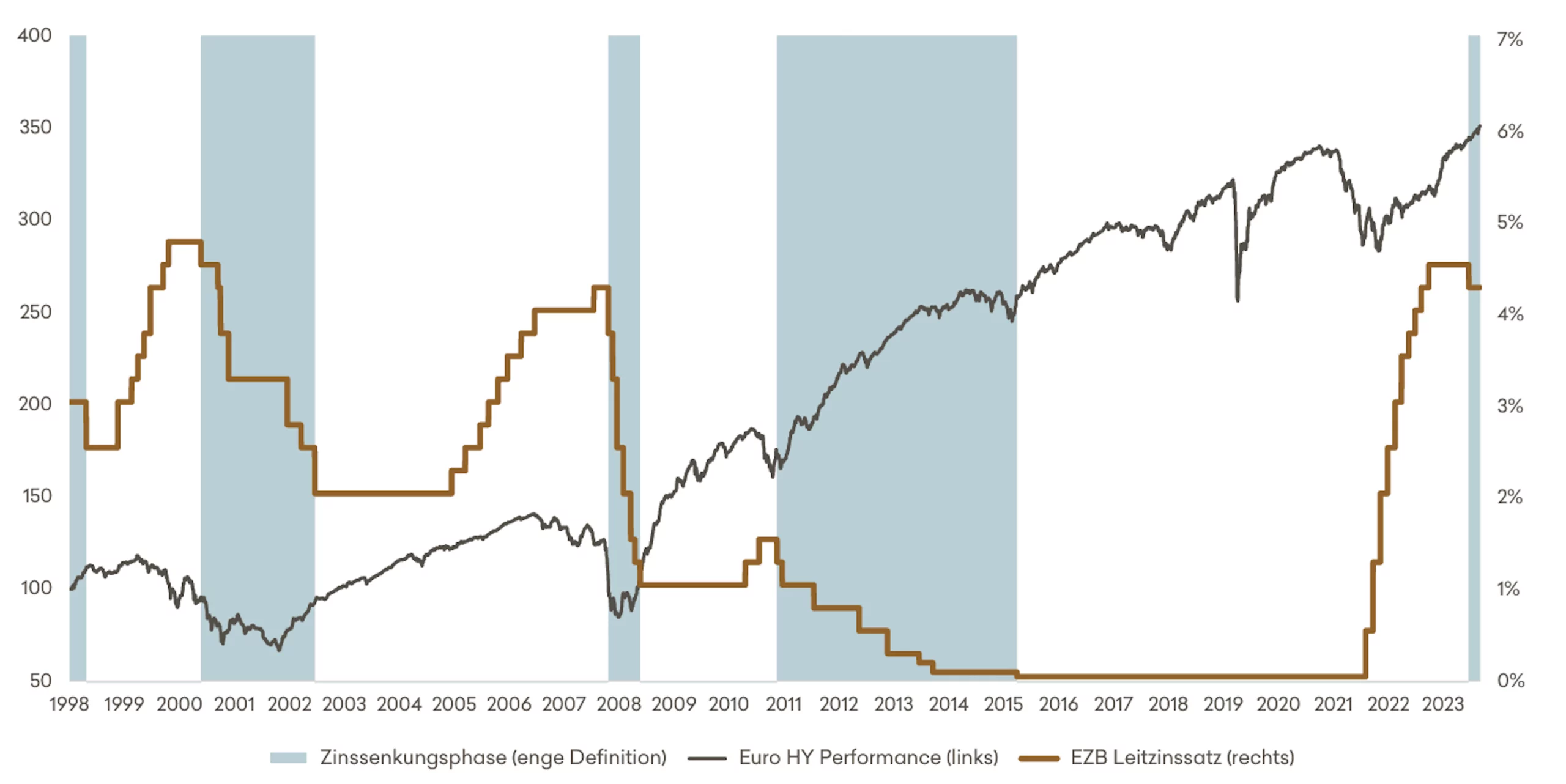
Source: Bloomberg, ICE BofA Euro High Yield Index (HE00), “rate cut cycle” (narrow definition) = first through last rate cut
2024?
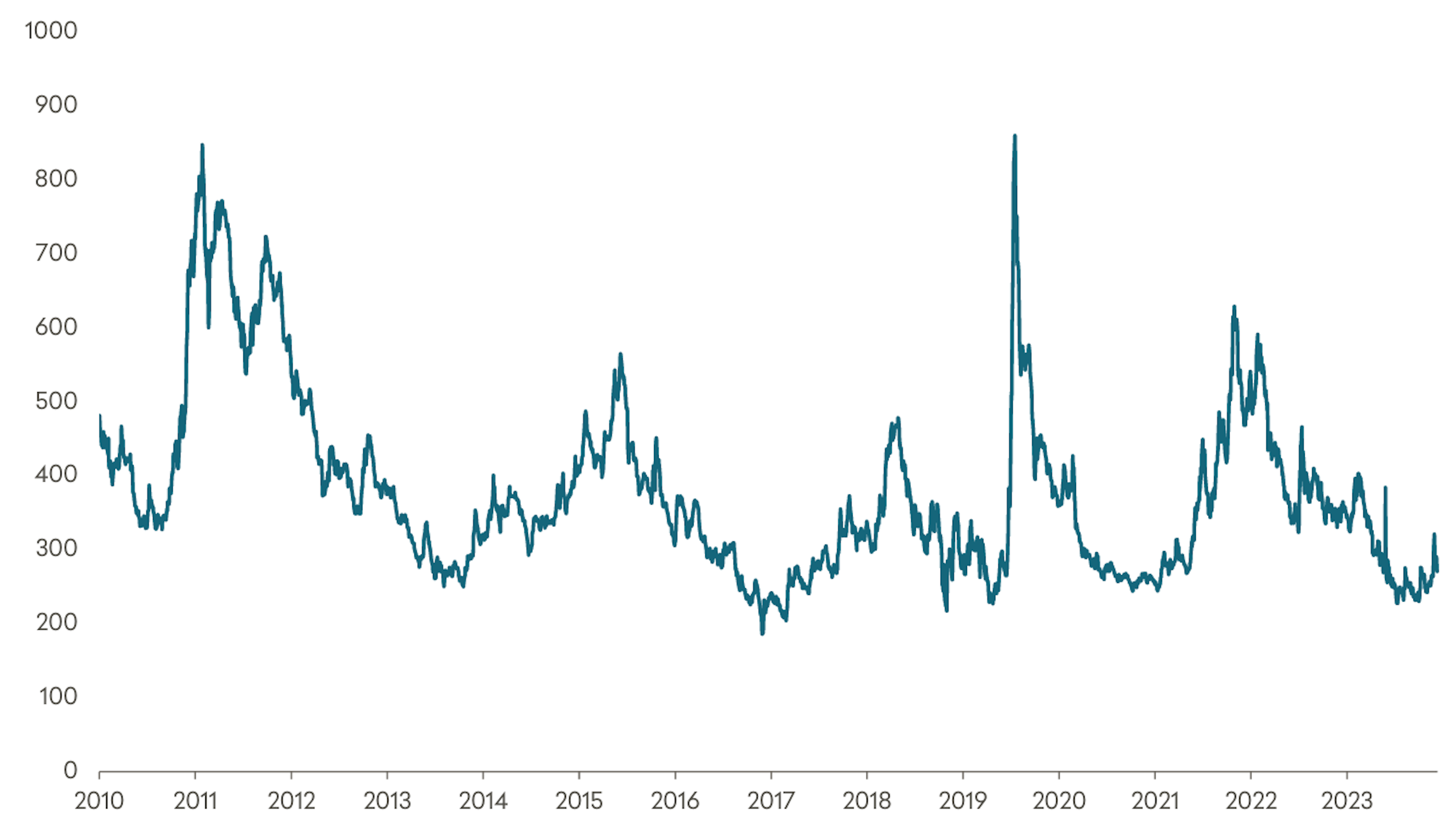
Source: Bloomberg, Bloomberg Euro High Yield ex Financials BB-B 3% Capped Total Return Index (H23969EU Index)
Conclusion:
The current cycle of interest rate cuts cannot be compared to any of the previous cycles—we are neither in the midst of an acute crisis nor do we need to fear significant price declines, nor are we currently seeing elevated risk premiums that would lead us to expect a significant tightening and the resulting sharp price movements.
Instead, investors should expect a rather unspectacular high-yield performance this time around—namely, roughly in line with the current yield of 5–6%. While interest rate cuts do stabilize economic growth and can prevent risk premiums from widening, there isn’t much room left for further tightening at current levels.
In an environment where central banks explicitly base their decisions on data (“data-dependent”), periods of conflicting or even disappointing economic data can lead to temporary increases in volatility. Active investors focused on fundamental analysis can capitalize on this through skillful stock selection.
For this reason, it is advisable to entrust investments in corporate bonds in general—and high-yield bonds in particular—to a proven fixed-income credit specialist. At HAGIM, we believe our investment philosophy—based on in-depth fundamental credit analysis—equips us to handle such challenges exceptionally well.

Risks
Price losses due to increases in yields and/or higher risk premiums are possible. A total loss cannot be ruled out either. Past performance is not indicative of future results, nor can future performance be guaranteed.
Disclaimer
This marketing communication, as defined by the Securities Trading Act, is provided solely for informational purposes and should not be construed as personal investment advice, a recommendation, or a solicitation to buy, sell, or hold a financial instrument, or to adopt an investment strategy.
The opinions and statements contained in this document reflect the current assessment as of the date of publication. The information provided does not constitute a complete analysis of all material facts relating to a country, region, or market.
Any statements regarding market trends, returns, price gains, or other increases in asset value, as well as risk metrics, are merely forecasts, and we assume no liability for their realization. In particular, past performance, simulations, or forecasts are not a reliable indicator of future performance. Asset values may rise or fall. All information has been carefully compiled, in some cases based on information from third parties. Individual pieces of information may, in particular due to the passage of time, changes in the law, or current market developments, prove to be no longer accurate—or no longer fully accurate—even at short notice, and are subject to change at any time without prior notice. Therefore, no warranty is provided as to the accuracy, completeness, or timeliness of any information. The information is based on our assessment of the current legal and tax situation. To the extent that tax or legal matters are addressed, the recipient should discuss these with their tax advisor or attorney. Investments in financial instruments involve both opportunities and risks. HAGIM’s policy on handling conflicts of interest is published online at www.ha-gim.com/rechtliche-hinweise. The information contained herein is intended solely for professional clients or eligible counterparties. This information document is not intended for U.S. citizens or persons permanently residing in the United States, nor may it be distributed in the United States.