


The success of Chinese electric vehicles is remarkable. Learn how this breakthrough is affecting risk premiums in the bond market and what implications this has for investors.
Bond Management in an Era of Technological Disruption
The vehicle is the Speed Ultra 7 (SU7) sedan, with a starting price of RMB 215,900 (USD 30,000)—about USD 4,000 cheaper than Tesla’s Model 3 sedan. The launch was highly successful, with over 50,000 orders placed within 27 minutes of sales beginning. The company sold over 10,000 cars in June 2024, a figure already comparable to the 9,000–10,000 monthly EV sales of the China-based joint ventures of SAIC Volkswagen and SAIC General Motors.
On May 23, 2024, Xiaomi’s management confirmed that demand remained strong, with delivery times for new orders extending beyond seven months. Xiaomi’s automobile plant was set to switch to two-shift operations in June 2024 to increase production capacity to 20,000 vehicles per month.
Such volumes would make Xiaomi one of the largest Chinese automakers in terms of global EV sales, as shown in the chart.
May 2024: Global Sales Figures for Chinese EV Manufacturers
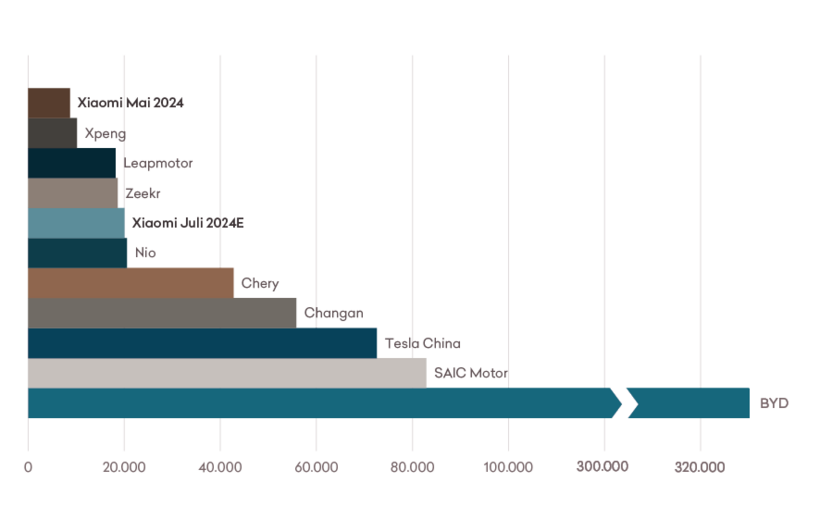
Source: China Association of Automobile Manufacturers
The successful launch of Xiaomi’s EV could have several implications for investors:
Other Markets Are Also Vulnerable
Risk Premiums Will Adjust to the New Industry Dynamics
Xiaomi’s entry into the EV market has already prompted competitors to announce further price cuts and subsidies, which could accelerate the transition to EVs. Xiaomi’s team of over 1,000 employees working on autonomous driving could also make a significant contribution to the development of this technology, even if the company itself does not become a major global automaker.
Risks and Analysis: Lessons from History and Strategic Outlook
According to reports, Xiaomi is already working intensively on developing a second model to compete with the current bestseller in the global EV market, the Tesla Model Y.
In an environment of rapid industry changes and fierce competition, sound credit analysis is crucial for avoiding loss-making investments. HAGIM relies on in-depth fundamental analysis to successfully navigate such challenges.
Image credit: Unsplash
Risks
Price losses due to rising yields and/or increased risk premiums are possible. Even a total loss cannot be ruled out. Past performance is not indicative of future results, nor can future performance be guaranteed.
Disclaimer
This marketing communication, as defined by the Securities Trading Act, is provided solely for informational purposes and should not be construed as personal investment advice, a recommendation, or a solicitation to buy, sell, or hold a financial instrument, or to adopt an investment strategy.
The opinions and statements contained in this document reflect the current assessment as of the date of publication. The information provided does not constitute a complete analysis of all material facts relating to a country, region, or market.
Any statements regarding market developments, returns, price gains, or other capital appreciation, as well as risk metrics, are merely forecasts for which we assume no liability. In particular, past performance, simulations, or forecasts are not a reliable indicator of future performance. Asset values may rise or fall.
All information has been carefully compiled, in some cases based on information from third parties. Individual pieces of information may, in particular due to the passage of time, changes in the law, or current market developments, prove to be no longer accurate—or no longer fully accurate—even at short notice, and may change at any time without prior notice.
Therefore, no warranty is provided as to the accuracy, completeness, or timeliness of any information. The information is based on our assessment of the current legal and tax situation. To the extent that tax or legal matters are addressed, the recipient should discuss these with their tax advisor or attorney.
Investments in financial instruments involve both opportunities and risks. HAGIM’s policy on handling conflicts of interest is published online at www.ha-gim.com/rechtliche-hinweiserechtliche-hinweise.
The information contained herein is intended solely for professional clients or eligible counterparties. This information document is not intended for U.S. citizens or persons permanently residing in the United States, nor may it be distributed in the United States.