


Steffen Ullmann
Senior Portfoliomanager Investment Grade
Die aktuellen Entwicklungen im Automobilsektor reflektieren eher eine Normalisierung als rezessive Niveaus. Noch können die meisten Automobilhersteller dieses Risiko durch ihre derzeit robusten Bilanzen ausgleichen. Doch die Branche muss nun ihren Worten Taten folgen lassen. Daher bleiben wir trotz höherer Spreads selektiv.
Normalization Instead of Recession:
The latest news from the automotive industry is alarming—especially for the German labor market. Even though the news is not encouraging, from a bondholder’s perspective, it is important to note that the revised profitability outlooks are close to historical medians. In the wake of the COVID-19 pandemic, the current trend points toward normalization rather than recessionary levels.
Profitability of Automobile Manufacturers
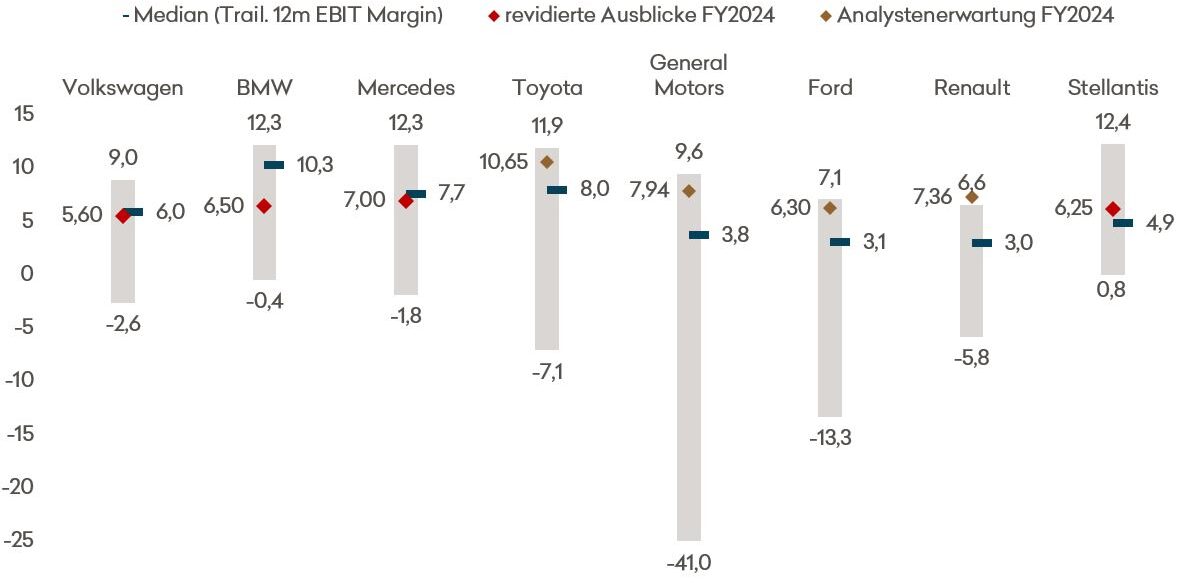
Source: Trailing 12-Month EBIT Margin, Bloomberg, company data, own presentation, period: 2009 through September 30, 2024
The crisis is hitting strong balance sheets:
Current operational developments are compounded by the industry’s long-term, structural challenges: in our view, regulation, competition, and technological change are significantly increasing business risk in the automotive sector. For now, most automakers are still able to offset this risk thanks to their currently robust balance sheets.
However, risk premiums in the automotive sector reacted sharply to the recent profit warnings and widened significantly compared with the rest of the market. In particular, the sector’s credit curve has become noticeably steeper than it was six months ago and now reflects the current environment and the sector’s long-term structural trends much more accurately.
Automotive Sector: Action, Not Just Words, Is Needed:
Changes in credit curves over the past 6 months
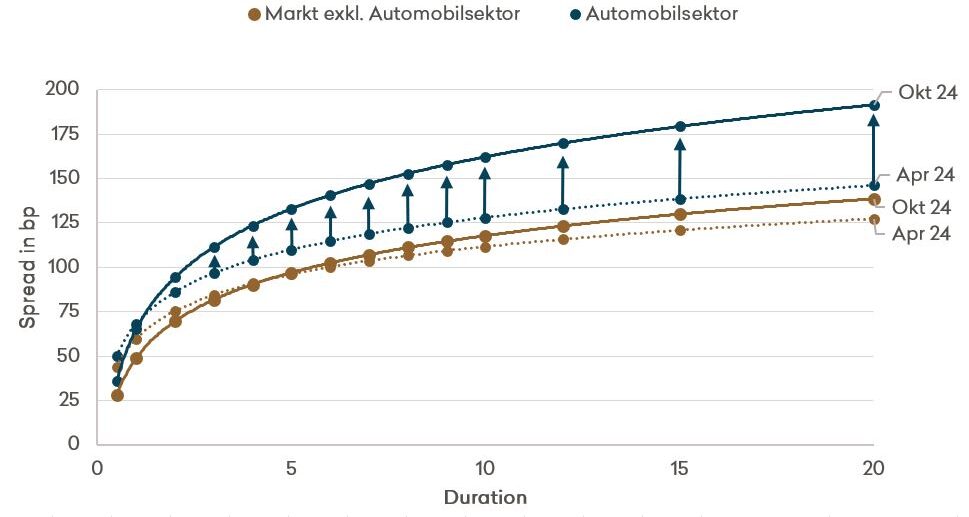
Source: Bloomberg EUR AGG Corporate ex Financials Total Return Index (LECFTREU Index), our own calculations, as of October 2, 2024
Despite the more attractive valuations, we believe the automotive sector has reached a clear “show me” moment. Before an overweight position can be considered, companies must first demonstrate that they are taking the right steps to address current challenges. This involves not only short-term cost reductions but also long-term strategic adjustments to changing market dynamics. We will closely monitor how automakers optimize their production capacities, drive innovation, and adapt their business models to electrification and digitalization. Only when we see concrete progress in these areas and a sustainable improvement in operating performance becomes apparent will we consider overweighting the sector. Until then, we will remain selective.
Risks
Price losses due to increases in yields and/or higher risk premiums are possible. A total loss cannot be ruled out either. Past performance is not indicative of future results, nor can future performance be guaranteed.
Disclaimer
This marketing communication, as defined by the Securities Trading Act, is provided solely for informational purposes and should not be construed as personal investment advice, a recommendation, or a solicitation to buy, sell, or hold a financial instrument, or to adopt an investment strategy.
The opinions and statements contained in this document reflect the current assessment as of the date of publication. The information provided does not constitute a complete analysis of all material facts relating to a country, region, or market. No financial analyses are provided.
Any statements regarding market trends, returns, price gains, or other increases in asset value, as well as risk metrics, are merely forecasts, and we assume no liability for their realization. In particular, past performance, simulations, or forecasts are not a reliable indicator of future performance. Asset values may rise or fall. All information has been carefully compiled, in some cases based on information from third parties. Individual pieces of information may, in particular due to the passage of time, changes in the law, or current market developments, prove to be no longer accurate—or no longer fully accurate—even at short notice, and are subject to change at any time without prior notice. Therefore, no guarantee is provided as to the accuracy, completeness, or timeliness of any information.
Please research all costs relevant to you on your own. Maintaining a securities account may incur costs; in addition, ongoing bank fees may apply. Transaction costs depend on the asset class: For government bonds and secured bonds such as mortgage bonds, they average about 0.02 percent; for corporate bonds, 0.085 percent. For less liquid bonds, transaction costs can also be significantly higher than 0.25 percent. It should also be noted that transaction costs may temporarily be significantly higher during periods of market stress. For all products distributed by HAGIM, all relevant cost information is provided prior to purchase.
The information provided is based on our assessment of the current legal and tax situation. To the extent that tax or legal issues are involved, the recipient should discuss them with his or her tax advisor or attorney.
Investments in financial instruments involve both opportunities and risks. HAGIM’s policy on handling conflicts of interest is published online at https://www.ha-gim.com/rechtlichehinweise. The information contained herein is intended solely for professional clients or eligible counterparties. This information document is not intended for U.S. citizens, persons permanently residing in the United States, or legal entities domiciled in the United States, nor may it be distributed in the United States.