


Investing in Times of Convergence and Regime Change
The Blurring Lines Between Developed and Emerging Markets
The traditional segmentation of credit markets into developed markets (DM) and emerging markets (EM) is becoming increasingly inadequate for today’s market structures. While countries such as Poland, South Korea, and Chile are achieving institutional standards comparable to or superior to those of Southern Europe, parts of the developed world have abandoned fiscal discipline or orthodox monetary policy. In terms of many fundamental metrics—debt ratios, fiscal stability, and governance indicators—numerous emerging markets have caught up with or even surpassed the DM over the past three decades.
For institutional investors, this has two implications: The diversification benefits of traditional emerging market allocations have declined significantly. However, despite this convergence, risk premiums in emerging markets remain structurally higher—a source of alpha that is difficult to capture using traditional benchmark approaches.
The Traditional Worldview of the Capital Markets
The bond indices’ view of the world is binary. On one side are the developed markets—stable, legally secure, and reliable; on the other are the emerging markets—volatile, risky, and up-and-coming. This dichotomy shapes not only the rhetoric of investment committees but also the concrete structures of institutional portfolios: separate mandates for “emerging markets,” dedicated risk budgets, and flat-rate capital add-ons under Solvency II.
The problem is this: These assumptions no longer hold true today. The EM category has become so heterogeneous over the past three decades that it has effectively lost its significance as a uniform asset class. At the same time, the institutional quality of some developed markets has deteriorated—not dramatically, but measurably. The cause of the persistent premiums lies not in poorer fundamental data quality, but in traditional labeling and categories that have evolved through regulation and no longer align with actual risk dynamics.
Aggregate Convergence
The convergence in institutional quality between developed and emerging markets has been a structural trend over the past three decades. The World Bank’s Worldwide Governance Indicator for the rule of law measures the extent to which actors trust and adhere to social norms—specifically, the quality of contract enforcement, property rights, the police, and the courts, as well as the likelihood of crime and violence.
Difference in Rule of Law Scores Between Developed and Emerging Markets
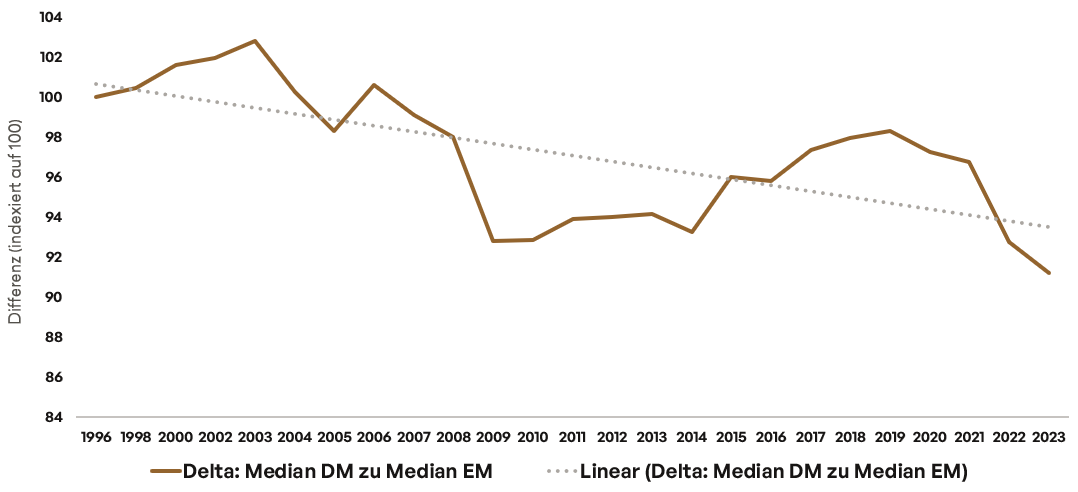
Fig. 1: Aggregate institutional convergence. Difference in rule-of-law scores between developed and emerging markets (median DM minus median EM), indexed to 100 (base year 1996). The decline to approximately 91 over 27 years illustrates the structural convergence. Source: World Bank Worldwide Governance Indicators, author’s calculations.
The gap between the average score of developed markets and that of emerging markets has narrowed by about nine percent since 1996. What once fundamentally distinguished developed markets from emerging markets—the reliability of legal institutions, the enforceability of contracts, and the protection of property rights—has, to some extent, dissipated over the course of a generation.
This convergence is not due to a single cause. On the one hand, many emerging economies have implemented institutional reforms driven by the need to attract international capital. Poland and the Czech Republic benefited from the European Union’s accession criteria. South Korea has continuously invested in the quality of its judiciary and the independence of its regulatory agencies over the course of four decades.
On the other hand, developed markets are showing measurable signs of erosion. Italy and Greece experienced a loss of confidence during the euro crisis. The United States is experiencing political polarization and recurring dramas surrounding the debt ceiling, which have reduced the predictability of economic policy.
The Overlap of Levels
However, looking at the median masks a crucial insight: trends within both categories are extremely heterogeneous. A cluster analysis of rule-of-law scores over the period from 1996 to 2023 shows that the levels now overlap—with far-reaching implications for portfolio construction.
Trends in Rule of Law Scores by Country Group (1998–2023)

Fig. 2: Overlapping Levels. Trends in Rule of Law Scores by Country Group (1998–2023). It is not only the top performers among emerging markets (Poland, South Korea, Chile, the Czech Republic, and the Baltic states) that have reached levels comparable to or superior to those of core developed market countries. At the same time, some developed markets (Italy, Greece) are showing concerning downward trends. Source: World Bank Worldwide Governance Indicators, own calculations.
The chart shows two findings that are relevant for asset allocators:
First, the top institutional performers among emerging markets—Poland, South Korea, Taiwan, Chile, the Czech Republic, the Baltic states, and Uruguay—have reached levels comparable to those of established core developed markets. Poland is an EU member, fully integrated into German value chains, and holds an A rating from Standard & Poor’s—one notch higher than Italy. These countries are technically emerging markets, but institutionally, they have long since arrived.
Second, some developed markets are showing concerning trends. Italy, Greece, and Malta are exhibiting a measurable downward trend in institutional quality. This erosion is not reflected in traditional asset allocation models—a Polish issuer is subject to higher capital requirements than an Italian one, even though the fundamentals suggest the opposite.
The Implications for Portfolio Construction
This reality should be reflected in sensible portfolio constructions. The traditional approach—treating emerging markets as a separate risk allocation with its own beta—leads to two problems:
The first problem concerns the beta construction. Those who allocate to EM without differentiation are, in reality, buying a heterogeneous mix of institutionally mature countries like Poland, classic emerging markets like Brazil, and fragile states like Nigeria. These countries have fundamentally different risk drivers, yet they are lumped together under a single beta. The result is an imprecise exposure that delivers neither the diversification one expects nor the risk premium one deserves.
Polish corporate bonds now correlate more strongly with German bonds than with Brazilian ones. The reason is obvious: Polish companies are an integral part of German and European supply chains. Anyone who keeps Poland in the EM bucket is constructing a beta that does not reflect the actual risk drivers.
Das zweite Problem betrifft die Alpha-Erschließung. Trotz der fundamentalen Konvergenz bleiben die Risikoprämien in EM strukturell höher. Die Gründe sind nicht fundamental, sondern strukturell: Mandate sind entlang der EM/DM-Grenze organisiert, Index-Provider gewichten nach historischen Kriterien, Solvency II behandelt EM pauschal mit höheren Kapitalanforderungen. Das Ergebnis ist eine systematische Fehlbewertung: Rating-äquivalente EM-Emittenten handeln mit höheren Spreads als DM-Emittenten, obwohl die Fundamentaldaten vergleichbar oder besser sind.
This source of alpha is difficult to capture using traditional benchmarking approaches. A manager with a separate EM mandate does not compete directly with a EUR-IG manager for capital. This artificial separation prevents direct comparison: a Polish utility company versus an Italian utility company, a South Korean technology conglomerate versus an American semiconductor manufacturer.
Clean Beta, New Alpha
This gives rise to specific requirements for modern portfolio construction:
To ensure a clean beta, risk drivers must be correctly assigned. Institutionally established emerging markets such as Poland or South Korea belong in the same risk budget as comparable developed-market issuers. Traditional emerging markets such as Brazil or Mexico constitute a separate exposure with their own risk drivers. The formal category is secondary—what matters is the actual risk dynamics.
To tap into alpha, this artificial distinction must be overcome. Those who focus on credit quality and cash flow structure—regardless of whether an issuer is classified as “EM” or “DM”—can capitalize on the structural inefficiencies arising from this outdated categorization. This requires integrated mandates that enable direct comparison, as well as a willingness to consistently evaluate issuers based on fundamental criteria.
The Limitations of the Thesis
As convincing as the argument may be, it has its limits. Investing in emerging markets remains a matter of selection. Even for established emerging markets, sovereign risks can never be completely eliminated. South Korea is located in a geopolitically sensitive region. Chile has experienced social unrest. These risks are real and require ongoing analysis.
This leaves asset allocators with two options:
Either adopt a more granular segmentation—treating established EM, traditional EM, and frontier markets separately—or accept that, for parts of the EM universe, old correlation patterns no longer apply and that “reversion-to-the-mean” arguments are misguided in the face of structural changes in risk drivers.
Conclusion
The binary distinction between emerging and developed markets, which has shaped asset allocations for decades, no longer reflects reality. The empirical evidence is clear: some emerging markets have reached institutional levels comparable to those of the German mark. Some developed markets are showing alarming signs of erosion. The levels overlap.
This reality calls for an adjustment to portfolio construction. Investors who continue to treat emerging markets as a homogeneous risk allocation are constructing an imprecise beta and squandering alpha. By contrast, investors who combine risk drivers rather than regions and evaluate issuers based on credit quality rather than labels can take advantage of the structural inefficiencies arising from this outdated distinction.
This requires deeper analysis and the courage to think beyond formal categories. But it is the logical path to constructing clear exposures in a world of blurring boundaries and capturing risk premiums that are structurally too high.
What does this mean for our CIO Series?
We move beyond formal categories and focus on credit quality, cash flow structure, and investment objectives—regardless of whether an issuer is classified as “EM” or “DM.”
Our modular platform takes advantage of the structural inefficiencies that arise from this outdated separation:
.1. Quality:
We select issuers with robust business models and clear financial fundamentals—whether in Warsaw or Milan is of secondary importance
2. Diversification:
We combine risk drivers rather than regions. This creates true stability—not the supposed “benchmark diversification,” which regularly collapses during periods of stress.
3. Predictability:
Through optimized portfolio structures, stable cash flows, and strict control, we deliver the return profiles that are crucial in a fragmented market environment.
Learn more about the HAGIM CIO Series here:
Risks
Price losses due to increases in yields and/or higher risk premiums are possible. A total loss cannot be ruled out either.
Past performance is not an indication of future results, nor can future performance be guaranteed.
Disclaimer
This marketing communication within the meaning of the German Securities Trading Act
(Wertpapierhandelsgesetz) is provided for information purposes only and should not be construed
as personal investment advice or a recommendation or solicitation to buy, sell or hold
any financial instrument or to adopt any investment strategy. The opinions and statements
contained in this document reflect the current assessment on the date of publication. This information does not constitute a complete analysis of all material facts relating to any country,
region or market. This is not to be considered as financial analysis.
If statements are made about market developments, returns, price gains or other asset
growth as well as risk ratios, these merely constitute forecasts for whose occurrence we assume
no liability. Past performance, simulations or forecasts in particular are not a reliable
indicator of future performance. Assets can go up as well as down. All information has been carefully compiled; partly with recourse to information from third parties.Individual details may prove to be no longer or no longer fully accurate, in particular as a result of the passage of time, changes in the law, current developments on the markets, possibly at short notice, and may change at any time without prior notice. Therefore, no guarantee is given that all the information is correct, complete and up to date.
Please inform yourself independently about all costs relevant to you. Maintaining a custody
account may incur costs; ongoing bank charges may also be incurred. Transaction costs depend
on the asset class: For government bonds and collateralised bonds such as mortgage
bonds, they average around 0.02 percent, for corporate bonds 0.085 percent. For less liquid
bonds, the transaction costs can also be significantly higher than 0.25 per cent. It should also
be noted that transaction costs can temporarily be significantly higher during periods of market
stress. For all products sold by HAGIM, all relevant cost information is made available
prior to purchase.
The information is based on our assessment of the current legal and tax situation. If tax or
legal matters are affected, these should be discussed by the addressee with their tax advisor
or lawyer. Investments in financial instruments are associated with both opportunities and
risks. The handling of conflicts of interest at HAGIM is published online in the legal notice on
https://www.ha-gim.com/en/legal-information. The information contained in this document
is intended for professional clients and eligible counterparties only. This information document
is not directed at US citizens or permanent residents, nor to legal entities domiciled in
the USA, nor may it be distributed in the US.