


Authors


Brazilian corporate bonds are not benefiting from the strong year in emerging markets. The recent weakness reflects an event that upset the balance in a market where macroeconomic conditions had already been weighing on corporate bonds for some time. The volatility during this period revealed several interesting observations.
A Year of Divergence
Emerging markets (EM) are experiencing one of their strongest years in a long time. The Bloomberg EM Aggregate Index has posted a gain of +10.46%¹ so far this year, supported by interest rate cut cycles in several countries and robust fundamentals. Brazil, however, is a notable exception: with a year-to-date return of 5.91%², the country ranks among the weakest EM markets. For investors who paid attention to the fundamentals, this weakness came as no surprise.
¹Bloomberg, I00014US Index, as of November 14, 2025
²Bloomberg, I00515US Index, as of November 14, 2025
Structural Stress Factors
Since August 2022, real interest rates in Brazil (the policy rate minus year-over-year inflation) have been ranging between 6% and 10%, an unusually high level for an economy with real growth of only 2% to 4%. High interest rates not only directly increase the refinancing costs for Brazilian issuers but also depress asset and equity valuations, limiting opportunities for capital raises or asset sales. This challenging environment increased the risk of a significant credit event, which occurred in late September.
Brazilian Corporate Bonds Under Pressure
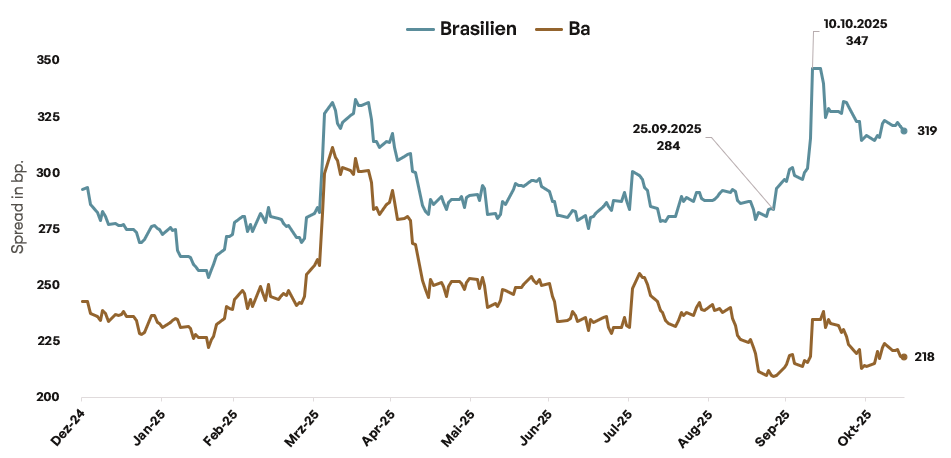
Source: Bloomberg, Bloomberg Emerging Markets Brazil Total Return Index (I00515US Index) and Bloomberg Emerging Markets Ba Total Return Index (I05040 Index); Period: December 31, 2024, through November 14, 2025.
Event-Driven Sell-Off
Braskem, one of the country’s largest corporate issuers, retained financial and legal advisors in late September to evaluate options for optimizing its capital structure. Historically, such a move has often preceded a default and, accordingly, triggered a broad sell-off across the entire market. In the two weeks between September 24 and October 10, spreads on the majority of Brazilian corporate bonds widened by 20–40 basis points, and by up to 400 basis points for issuers with weaker fundamentals. Notably, 96% of all issuers saw their spreads widen.
The broad-based widening points to signs of spillover effects, but the decile analysis quantifies just how uneven the adjustment actually was: The bottom decile widened by 216 bps, while the top decile moved by only 4 bps. This distribution analysis complements the movement at the index level and underscores the high cross-sectional dispersion during the widening phase. During the recovery period from October 10 to November 14, spreads narrowed across all deciles in a nearly parallel manner, with the recovery clustering within a significantly narrower range—a pattern that clearly differs from the dispersion observed during the widening phase.
Differentiated Expansion, Parallel Recovery
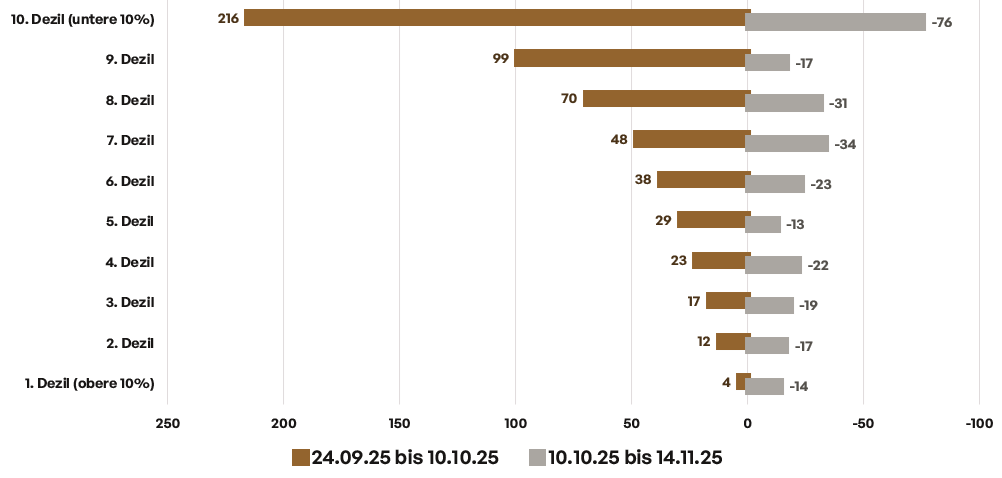
Source: Bloomberg, Bloomberg Emerging Markets Brazil Total Return Index (I00515US Index); our own calculations (excluding SAMMIN, OIBRBZ, and BRASKM); period: September 24, 2025, through November 14, 2025.
Understand Market Repricing Before You Trade
Periods of volatility often create opportunities for managers who take a fundamental approach. Whether the market moves with diverging spreads or more parallel narrowing—these phases tend to create mispricings that can result from shifts in liquidity, portfolio rebalancing, or short-term opportunistic flows. Before considering whether current spreads represent an entry point, it is essential to understand whether the company’s fundamentals or the original investment thesis have changed in response to the triggering event.
“Recent developments appear to have served as a catalyst for a reassessment in a market—
—that was already under considerable macroeconomic pressure.”
– Roman Nasonov, CFA

Source: Bloomberg (Bloomberg Emerging Markets Brazil Total Return Unhedged USD, I00515US Index; Bloomberg EM USD Aggregate Total Return Index Value Unhedged, I00014US Index)
Risks
Price losses due to increases in yields and/or higher risk premiums are possible. A total loss cannot be ruled out either.
Past performance is not an indication of future results, nor can future performance be guaranteed.
Disclaimer
This marketing communication within the meaning of the German Securities Trading Act
(Wertpapierhandelsgesetz) is provided for information purposes only and should not be construed
as personal investment advice or a recommendation or solicitation to buy, sell or hold
any financial instrument or to adopt any investment strategy. The opinions and statements
contained in this document reflect the current assessment on the date of publication. This information does not constitute a complete analysis of all material facts relating to any country,
region or market. This is not to be considered as financial analysis.
If statements are made about market developments, returns, price gains or other asset
growth as well as risk ratios, these merely constitute forecasts for whose occurrence we assume
no liability. Past performance, simulations or forecasts in particular are not a reliable
indicator of future performance. Assets can go up as well as down. All information has been carefully compiled; partly with recourse to information from third parties.Individual details may prove to be no longer or no longer fully accurate, in particular as a result of the passage of time, changes in the law, current developments on the markets, possibly at short notice, and may change at any time without prior notice. Therefore, no guarantee is given that all the information is correct, complete and up to date.
Please inform yourself independently about all costs relevant to you. Maintaining a custody
account may incur costs; ongoing bank charges may also be incurred. Transaction costs depend
on the asset class: For government bonds and collateralised bonds such as mortgage
bonds, they average around 0.02 percent, for corporate bonds 0.085 percent. For less liquid
bonds, the transaction costs can also be significantly higher than 0.25 per cent. It should also
be noted that transaction costs can temporarily be significantly higher during periods of market
stress. For all products sold by HAGIM, all relevant cost information is made available
prior to purchase.
The information is based on our assessment of the current legal and tax situation. If tax or
legal matters are affected, these should be discussed by the addressee with their tax advisor
or lawyer. Investments in financial instruments are associated with both opportunities and
risks. The handling of conflicts of interest at HAGIM is published online in the legal notice on
https://www.ha-gim.com/en/legal-information. The information contained in this document
is intended for professional clients and eligible counterparties only. This information document
is not directed at US citizens or permanent residents, nor to legal entities domiciled in
the USA, nor may it be distributed in the US.