



Thomas Herbert
CEO / CIO
Real Estate Debt: Defensive Cash Flows for High-Yield Portfolios
The real estate market offers institutional investors a wide range of investment opportunities. In terms of property types, a distinction is made, for example, between office, retail, logistics, industrial, hotel, life sciences, data centers, and residential. In the residential sector alone, there are further distinctions between traditional housing, micro/shared living, mixed-use residential neighborhoods, student housing, and healthcare real estate. The location (e.g., A, B, C, or D cities) and the property’s specific site also play an important role. In terms of risk profile and property condition, real estate is also categorized into Core, Core+, Value-Add, and Project Development. With regard to the form of financing, the entire capital structure—comprising equity and debt—is mapped out in all its known aspects. If an investor ultimately does not wish to make a direct investment, various vehicles—such as open-ended or closed-end funds—are also available. Consequently, it is difficult to make general statements about “the real estate market.”
Improved Framework Conditions
There are certainly a number of factors and developments that affect all segments of the German real estate market. The pandemic, ESG issues, inflation, and the interest rate shock—with its consequences of falling prices and rising insolvencies—have certainly created a very challenging environment for the overall market in recent years.
In 2025, however, lower money market interest rates, long-term interest rates that have remained largely stable for over two years, and easing inflation rates have led to a stabilization of macroeconomic conditions. Furthermore, there is now a clear political will in Germany to bring about lasting improvements to the regulatory environment of the real estate market.
However, various studies¹ show that the current situation in the real estate market remains highly varied and challenging. CBRE speaks of a gradual market recovery that continues to be characterized by a challenging environment. EY states that there is no sign of a sustainable market upturn. Colliers sees early signs of a recovery, while bulwiengesa continues to observe noticeable caution in the market despite these initial signs of improvement.
Residential real estate segment sees significant momentum
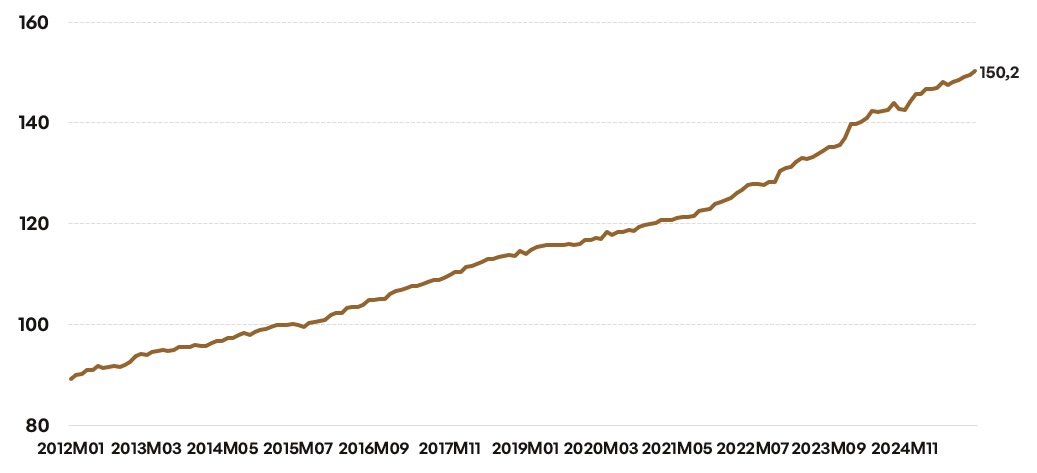
Good news about rising real estate prices—such as that reported in early November by the German Real Estate Index (GREIX) for residential real estate—is therefore drawing a great deal of attention. Furthermore, the GREIX Rent Index shows that rents rose by 4.5% year-over-year in the fourth quarter of 2025. This gives the rise in asking rents even greater momentum. Strong demand for residential real estate, coupled with sluggish improvements in supply, should continue to drive up rents in the residential segment in the coming years and thus at least further stabilize real estate prices.
Purchase price trends in market segments
GREIX Index, nominal, change in % compared to the same quarter of the previous year
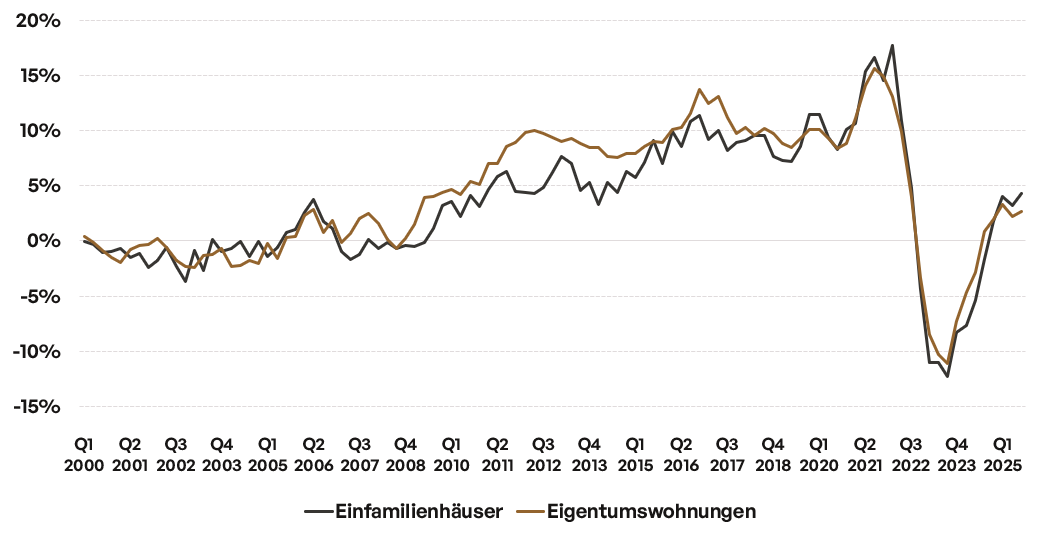
Source: GREIX, Kiel Institute for the World Economy
Rent price index
Monthly frequency based on advertised rents
The assessment of the real estate financing market compiled by JLL (DIFI Report) also shows residential real estate leading the way, both in terms of location and expectations. Among the institutions surveyed, this has recently led to slightly rising LTVs and falling margins for core residential real estate financing and can be interpreted as a sign of healthy competition.
Looking at the transaction statistics for the third quarter of 2025, the housing market also leads the way, both in terms of total volume and in terms of improvement compared to the same quarter of the previous year.
Price corrections in the housing market are thus likely to be over for the time being. Even if price increases on the scale seen between 2010 and 2020 are not likely to be repeated anytime soon, further sustained declines in value have become rather unlikely given the current market conditions. As a result, the housing market currently offers an attractive opportunity to enter the market.
Debt or equity—which is the better investment?
To assess the attractiveness of an investment in residential real estate, it is worth taking a look at the latest 5% study by bulwiengesa. The performance expectations for the residential submarkets examined in the study are summarized in the table below for core investments.
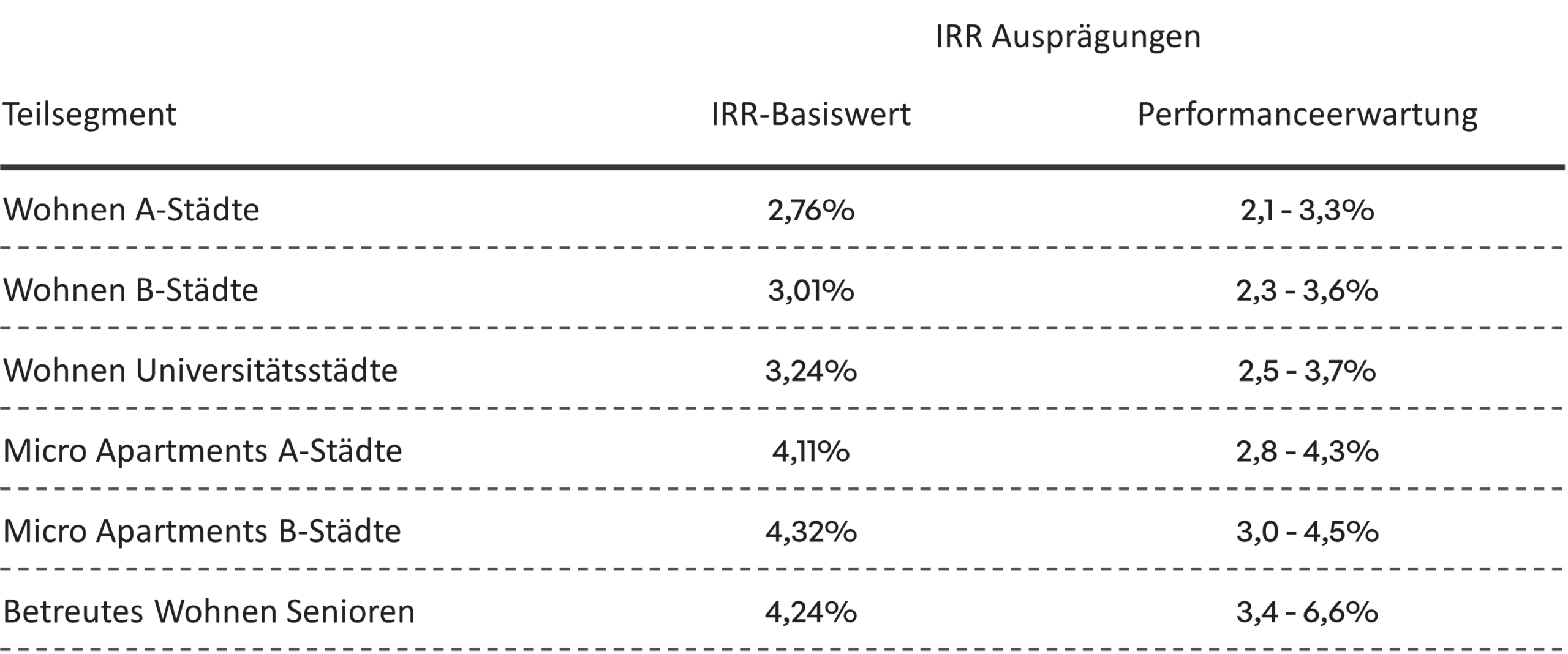
Source: bulwiengesa, The 5% Study 2025; assumed holding period of 10 years
In the traditional residential sector, performance expectations for core investments range from 2.1% to 3.7%. For micro-apartments, an IRR of up to 4.5% can be expected, and only in the assisted living sector for seniors can returns of up to 6.6% be achieved. However, even here, the benchmark of 4.24% falls below the 5% mark. When one considers that corresponding real estate prices fell by an average of just under 13% between 2022 and 2024, the risk-adjusted performance metrics are rather unsatisfactory.
We are currently observing that real estate debt funds are generating a gross IRR of between 7% and 8% in the current environment, with a distribution yield of up to 6% (Source: HAGIM, based on market observations). The returns mentioned above apply to funds that provide whole loans for senior financing in the institutional residential segment in prime locations, without any project developments included in the portfolio. Unlike banks, real estate debt funds offer slightly higher LTVs of 70 to 85% for their financing.
However, because of their priority in the event of insolvency, investments in senior-secured real estate loans represent a significantly less risky investment even at higher LTVs. However, the safety buffer shrinks as the LTV rises: at an 85% LTV, a 15% price decline is enough to trigger losses. On the other hand, following the 13% correction that has already occurred, a further decline would result in a cumulative drop of nearly 30%—which is unlikely in the residential segment given the supply-and-demand dynamics. Furthermore, the whole-loan investor is in the driver’s seat during restructurings: As the sole lender, they independently decide on terms, covenants, and foreclosure—without the intercreditor conflicts typical of traditional senior/mezzanine/equity structures.
Whole Loans and LTVs in the Current Environment
Prior to the massive market correction, a classic financing structure for the acquisition of an existing property with significant value-add potential often involved the use of equity, senior debt, and mezzanine debt. In such cases, the primary lenders—banks or insurance companies—often provided up to 65 or 70 percent of the project costs, while the sponsors typically contributed no more than 10 percent in equity. The difference was then usually covered by a subordinated loan bearing a higher interest rate.
As long as the financed capital expenditures are actually implemented in a way that adds value, real estate prices rise, and the property generates the expected cash flow, the property can be sold to a long-term institutional investor after three to five years. For these investors, leverage on the equity capital invested is typically limited to 50% or less, so that, given the cash flow, the investment is sustainable in the long term and generates market-rate returns for the new investor and the senior bank providing first-lien financing.
The situation is different if property values fail to appreciate and, in a less optimistic market environment, no long-term buyer can be found. If senior and mezzanine lenders are not willing to accept a significantly higher LTV based on the new valuation than they did in their original exit analysis, a financing gap will arise. If other lenders are found who are willing to close the gap, it can be assumed that financing costs will increase significantly. This, in turn, makes it less attractive for the sponsor to provide additional equity as collateral for the new lenders. In this scenario, refinancing is then hardly possible without painful compromises.
Following a significant market correction and with loan maturities looming, the existing capital structure often cannot be salvaged even through painful adjustments to loan agreements and term extensions (“Amend and Extend”). The combination of value depreciation and conservative lending practices can no longer be remedied without restructuring. And it is precisely in these situations that operating cash flow—and thus the quality of asset management—separates the wheat from the chaff. It is crucial that, from the outset, the asset manager professionally and promptly implements value-enhancing capital expenditure measures, thereby stabilizing rental income over the long term at a level that covers the cost of debt. This can give rise to opportunities in individual cases where the combination of fresh equity and a senior-secured whole loan can generate attractive returns even with only a moderate market recovery.
The numerical example shown in the table below is purely illustrative, contains highly simplified assumptions, and does not even begin to capture the complexity of real-world restructuring cases. It is intended merely to outline how whole loans generate attractive returns in the current market environment while offering a very high safety margin. In the example provided, the market price of the property could fall by another 20%—which would amount to 40% of the original investment cost or 52% of the exit value in the base case—before the senior secured lender incurs a loss. For the new equity investors, the current dividend is relatively low at first; nevertheless, a moderate market recovery would still lead to an attractive return and an exit strategy that appears feasible.
In essence, therefore, cash flow is king—and this is confirmed time and again in our restructuring practice.
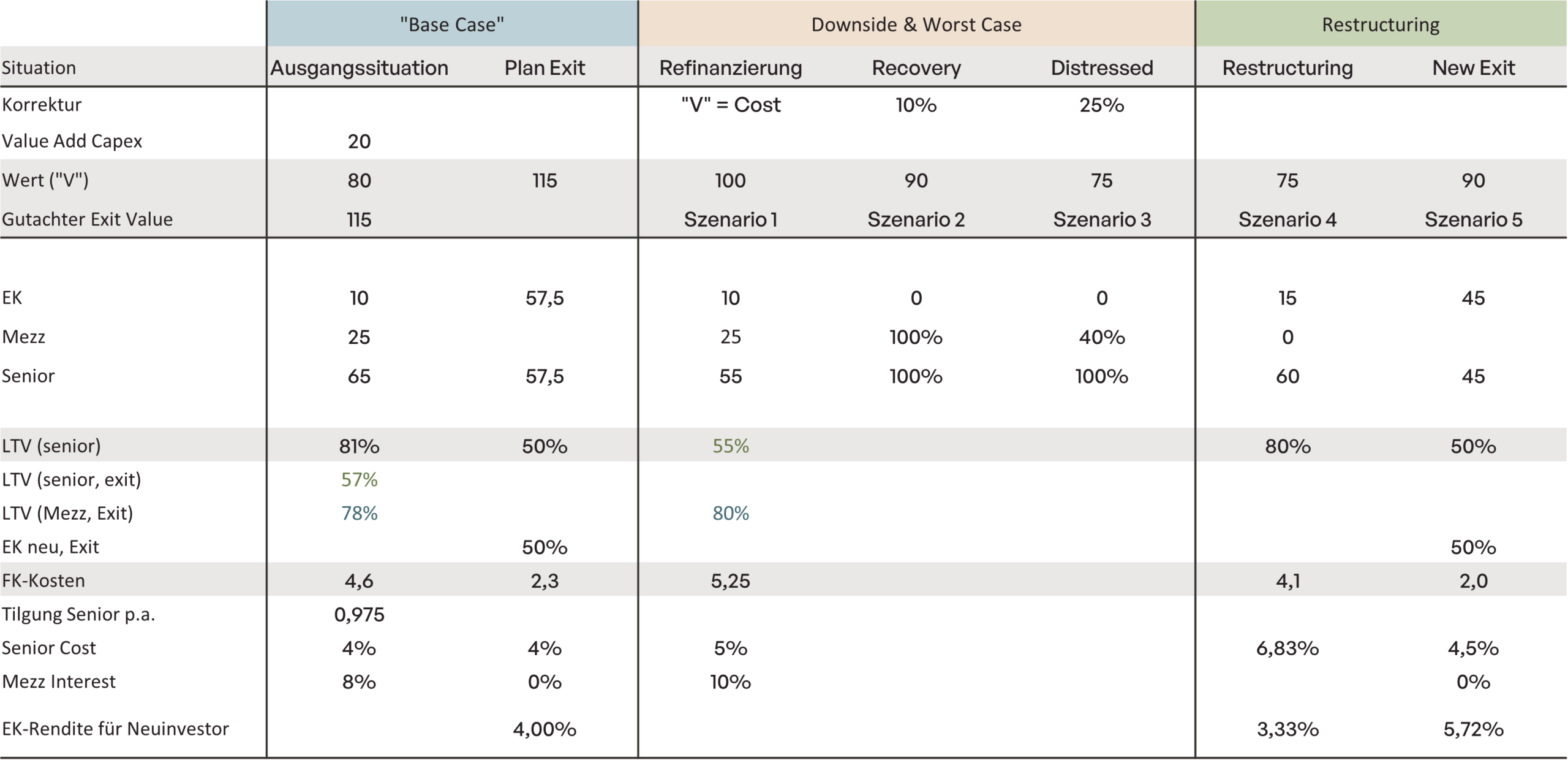
Source: HAGIM: The table is for illustrative purposes only, is based on highly simplified assumptions, and does not represent any specific financing situation known to us.
Real Estate Debt Funds: A Trend Toward Convergence
However, this illustrative example also shows that real estate debt funds are no longer primarily used to resolve complex financing situations involving high loan-to-cost ratios, weaker collateral, and challenging valuation assumptions. By providing senior-secured whole loans, real estate debt funds can offer simple and effective financing at a time when banks are largely unable to provide comparable solutions due to regulatory requirements. The fact that a volume of approximately 40 billion euros needs to be refinanced in the German real estate market should provide sustained support for the growth of the real estate debt market.
As a result, real estate debt funds are becoming more similar in risk profile to private debt funds focused on direct lending or senior secured loan funds. A comparison with corporate bonds issued by real estate companies is also interesting. While bonds generally represent an unsecured claim against the company’s real estate portfolio—which is often not very transparent—real estate debt funds offer comparable economic exposure to the real estate market. However, investors trade the liquidity of the bond for concrete collateral and transparency in the real estate debt investment and, in return for this trade-off, receive an attractive illiquidity premium with, in our view, reduced risk.
Risk-Return Combinations of Selected Credit Instruments
in a Portfolio Context
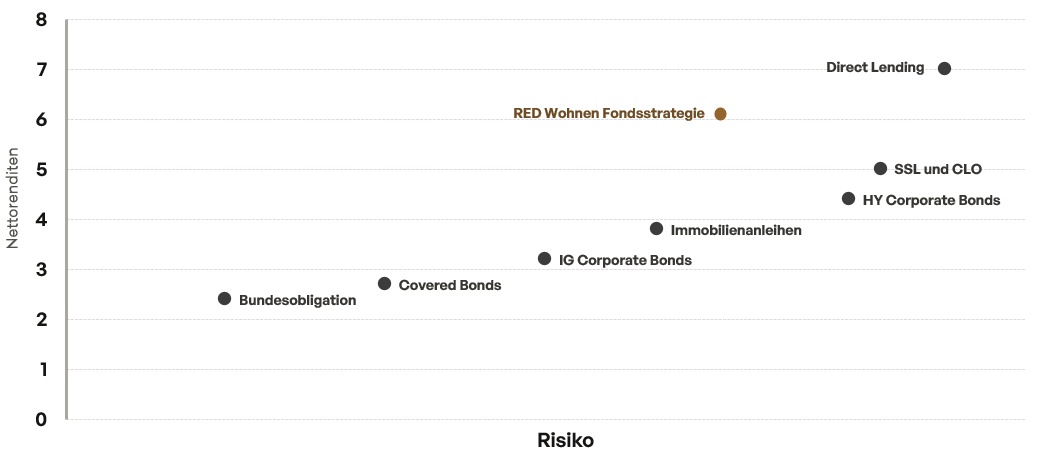
Source: HAGIM’s own survey based on its own market observations and discussions with experts
Of course, the risk-return points in the chart above are not constant over time. And it is obvious that there are a large number of different direct lending strategies with very different risk-return combinations. The dispersion of real estate or high-yield bonds is also significant. But even if one shifts individual points in the figure slightly higher here, slightly lower there, or to the left, the fundamental message remains valid in the current market environment: Real estate debt funds contribute to diversification in institutional investment and shift the efficiency frontier of fixed-income investments to the left. They offer an attractive portfolio component both in absolute terms and on a risk-adjusted basis. It is therefore fitting that, under the Investment Regulation, real estate debt funds are generally not included in the 25% real estate quota but are instead treated in accordance with Section 2(1)( 17 of the Investment Regulation (AnlV) and are thus allocated to the 7.5% alternative investment quota under Section 3(2)(2) of the AnlV.
Given the developments described and the product features outlined, the real estate debt fund segment is moving decisively out of its niche and has the potential to become an integral part of institutional portfolios. From a current valuation perspective, the timing could hardly be better.
Selecting a Provider
In addition to choosing an appropriate investment strategy, selecting the right fund provider is also very important when investing in a real estate debt fund. Experience—as measured by past loan origination and fund launches—is certainly a key factor here. The size of the team must also be commensurate with the fund manager’s ambitions. Finally, governance structures, the organization of internal processes, and the IT infrastructure must be closely examined.
Furthermore, alignment of interests between the fund provider and the investor is a particularly important aspect, especially for investments in private markets. This alignment is firmly established when the provider invests its own group’s funds, for example, in the form of seed capital. A particularly important factor in manager selection is that the provider has experience in restructuring real estate financing and handling insolvency situations. Two aspects are of great importance here: first, the fund provider’s ability and willingness to provide additional funds for promising investments and to protect capital already committed; and second, the network and infrastructure required to handle these complex situations.
If not now, then when?
The current market environment for investments in real estate debt funds focused on residential real estate is favorable. This is supported by the following:
- the clearly visible recovery in the residential real estate market, which, following the recent crisis, is still far from having reached all market segments.
- the attractive risk-return profile of debt funds—both compared to real estate investments and to other segments of fixed-income investments—with a focus on steady and predictable returns.
- the favorable entry point following the real estate crisis and the massive price corrections.
- The evolution of the real estate debt market segment from a niche for complex structures into a fundamental and transparent component of robust financing solutions at a time when banks are facing increasing regulatory pressure regarding lending.
Reliable rental income remains particularly important for institutional clients with long-term liabilities. Appreciation in value and hidden reserves often provide peace of mind on paper. However, they are of no help when robust cash flows are lacking in a crisis situation and the values cannot be realized due to a collapsed transaction market. In our current restructuring projects, we see time and again that a broken capital structure can usually be remedied when, among other factors, there are stable and long-term rental income streams. Value-add elements are generally attractive, but in this context, it is essential to pay close attention not only to the fund provider’s experience but also to the quality of asset management.
Against this backdrop, we believe the HAGIM Lenwood Real Estate Debt I (Residential) Fund is well-positioned to benefit from this changing environment in the real estate sector through whole-loan financing; mezzanine financing and development strategies are explicitly excluded. Institutional investors are offered not only an attractive risk-return profile but also the opportunity to make a sustainable social contribution through active participation in future-oriented real estate properties in Germany and selected European growth regions. This Article 8+ strategy focuses exclusively on existing real estate assets that contribute to social objectives, such as ensuring affordable housing, healthcare properties without operator risk, improving energy efficiency, or promoting social interaction. Regular cash flows from the financed properties enable a distribution yield of up to 6% per annum. This opens up an attractive window of opportunity for investments in real estate debt, especially now.
Sources:
¹ EY Parthenon, “Real Estate Crisis,” survey for Q3 2025; CBRE, “Germany Investment Market Q3 2025,” or JLL, “Investment Market Overview Q3 2025.”
Risks
Price losses due to increases in yields and/or higher risk premiums are possible. A total loss cannot be ruled out.
Past performance is not an indication of future results, nor can future performance be guaranteed.
Disclaimer
This marketing communication, as defined by the Securities Trading Act, is provided solely for informational purposes and is not a substitute for personalized investment advice tailored to the investor’s specific needs. To the extent that statements are made regarding market developments, returns, price gains, or other increases in asset value, as well as risk indicators, these are merely forecasts, and we assume no liability for their realization. In particular, past performance, simulations, or forecasts are not a reliable indicator of future performance. Asset values can rise as well as fall. All information has been carefully compiled, in some cases based on information from third parties. Individual pieces of information may, in particular due to the passage of time, changes in the law, or current market developments, prove to be no longer accurate—or no longer fully accurate—even at short notice, and are subject to change at any time without prior notice. Therefore, no warranty is provided regarding the accuracy, completeness, or timeliness of any information. No financial analyses are prepared.
Please research all costs relevant to you on your own. Maintaining a securities account may incur costs; in addition, ongoing bank fees may apply. Transaction costs depend on the asset class: For government bonds and secured bonds such as mortgage bonds, they average about 0.02 percent; for corporate bonds, 0.085 percent. For less liquid bonds, transaction costs can also be significantly higher than 0.25 percent. It should also be noted that transaction costs may temporarily be significantly higher during periods of market stress. All products managed by HAGIM are subject to a management fee, which may vary depending on factors such as portfolio size or asset class. For all products distributed by HAGIM, all relevant cost information is provided prior to purchase.
The information provided is based on our assessment of the current legal and tax situation. To the extent that tax or legal issues are involved, the recipient should discuss them with his or her tax advisor or attorney. Investments in financial instruments involve both opportunities and risks. HAGIM’s policy on handling conflicts of interest and its Best Execution Policy are published online at https://www.ha-gim.com/rechtliche-hinweise. The information contained herein is intended solely for Professional Clients or Eligible Counterparties. This information document is not intended for U.S. citizens, persons permanently residing in the United States, or legal entities domiciled in the United States, nor may it be distributed in the United States.