


Steffen Ullmann
Senior Portfolio Manager – Investment Grade
Half a year of upheaval—yet risk premiums remain virtually unchanged. Is the calm in the credit market deceptive? Or does it reflect genuine resilience? Read on to learn where we see the positives and negatives in the current credit environment.
1. Review: The First Half of the Year as a Test Case for a New Market Environment
The sheer number of events in the first half of 2025 could easily have filled a decade: Germany’s abrupt shift in fiscal policy, including the reform of the debt brake; the U.S.’s so-called “Liberation Day” [sic] with far-reaching import tariffs; ongoing global conflicts; and the gradual erosion of once-stable alliances—all of these factors are having a lasting impact on the current market environment.
For investors, the key question is: Are we witnessing the beginning of a profound period of structural upheaval with an uncertain outcome—or is this merely short-term noise? A look at the bond markets so far suggests the latter—because despite significant volatility resulting from a variety of events, spread levels remained virtually unchanged in the first half of the year.
Spreadentwicklung der Kreditmärkte 2025
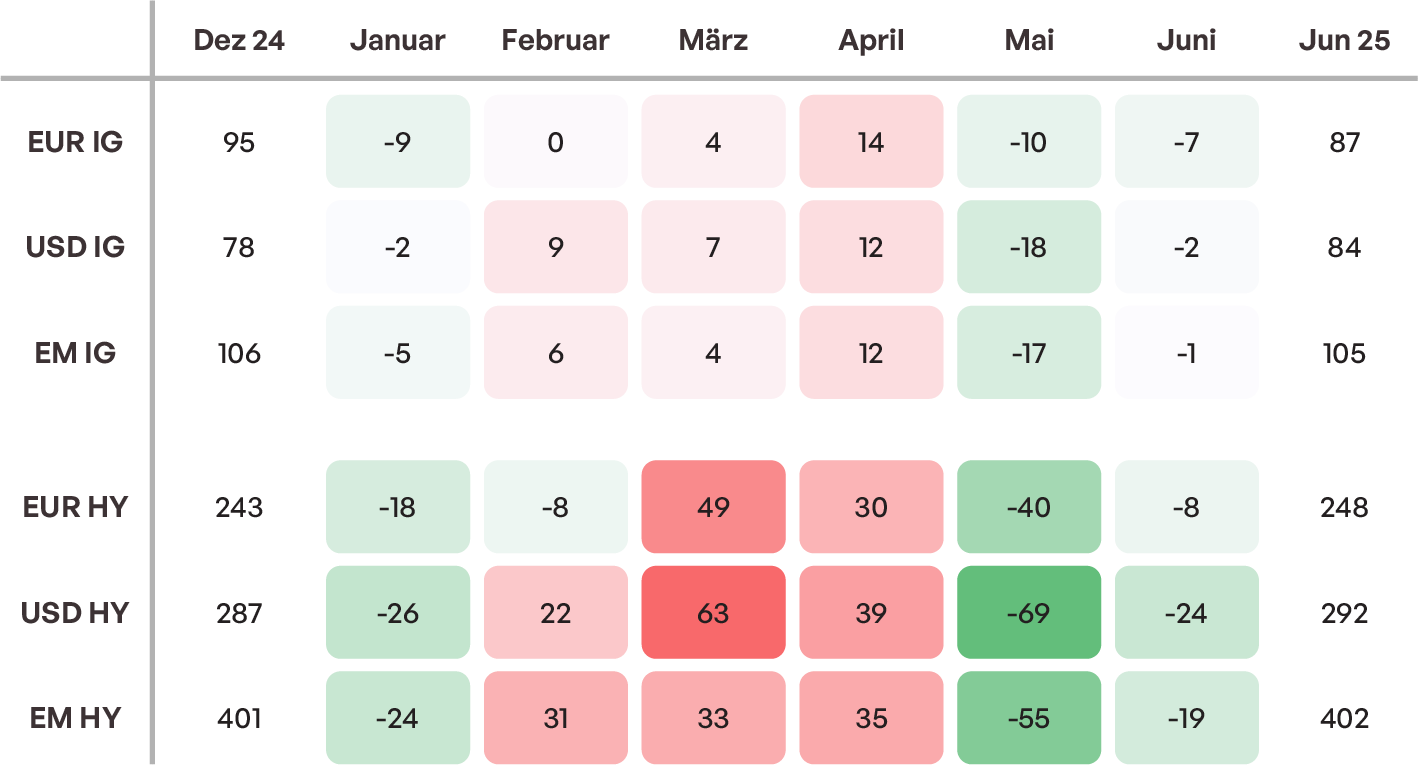
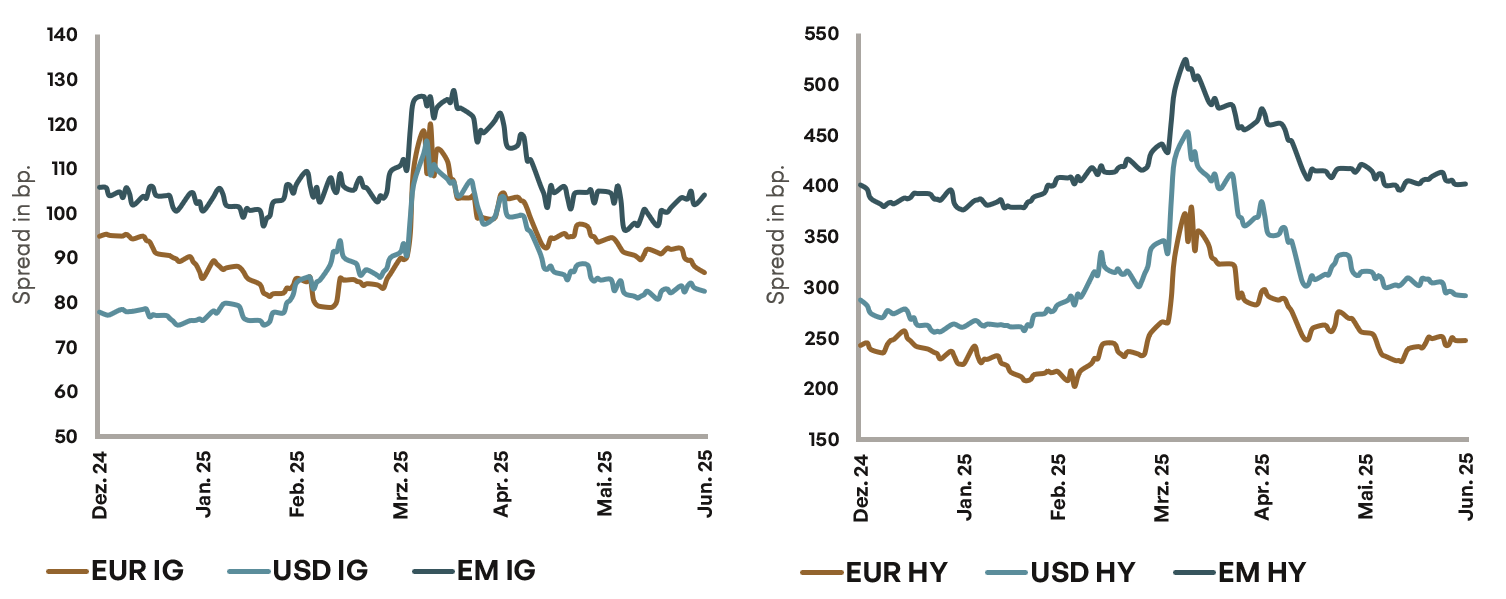
OAS on government bonds, Source: Bloomberg, EUR IG (LECFTREU), EUR HY (H23969EU), USD IG (LUAITRUU), USD HY
(LF98TRUU), EM IG (I04276US), EM HY (BEBGTRUU); Period: Dec. 31, 2024, through June 30, 2025
2. Business Conditions: Disciplined companies have built up financial buffers
Die Unternehmensbilanzen zeigen sich weiterhin in solider Verfassung. Ein Großteil der Emittenten weist They are generating stable margins and robust free cash flows. At the same time, thanks to strict financial discipline, debt ratios remain low, and the companies have built up buffers to weather difficult times.
Corporate Debt – A Regional Overview
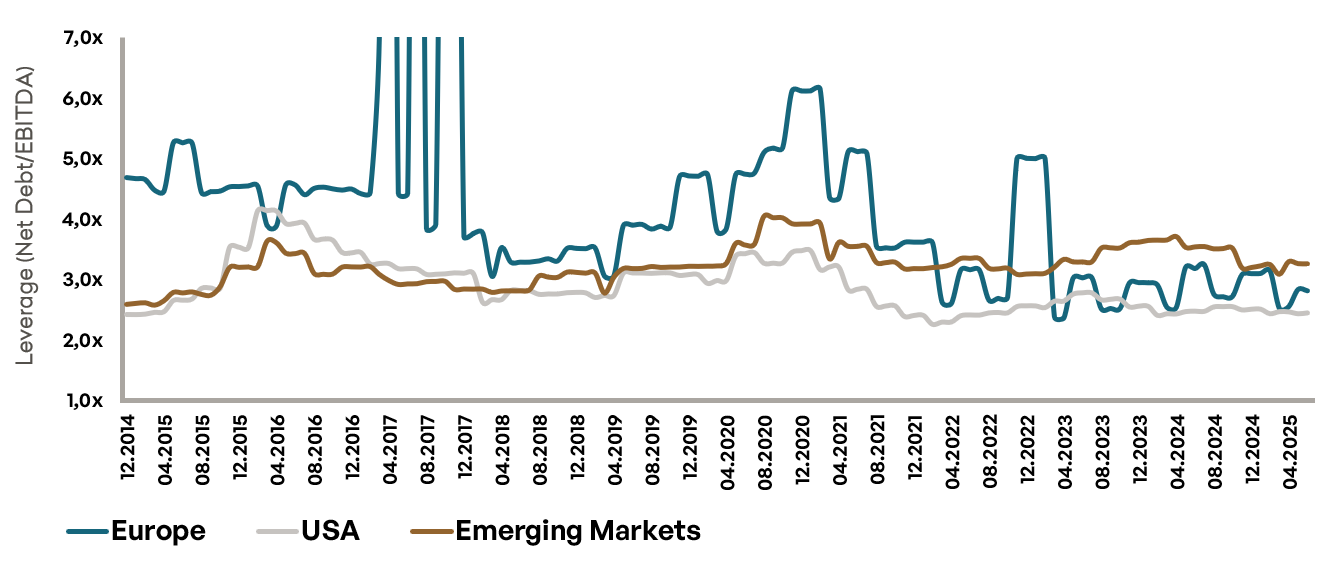
Source: Bloomberg; Net Debt / EBITDA (Field); Europe (MSCI Europe Equal Weight), U.S. (MSCI USA Equal Weight),
Emerging Markets (MSCI EM Equal Weight); Time Period: December 2014 – June 2025
3. Macroeconomic Environment: Structural uncertainty and political fragmentation are still being mitigated
The economic environment in the first half of 2025 was marked by ongoing uncertainty. Signs of a slowdown in global growth momentum are mounting—with the U.S. as the main driver. Leading indicators point to a slowdown in the robust growth seen in recent years: Purchasing Managers’ Indices (PMIs) have cooled, and the OECD’s leading indicators signal an economic slowdown in the U.S. At the same time, it should be noted that labor market data and other real economy indicators paint a robust picture. Given recent history—in which leading indicators predicted a recession that ultimately did not materialize—this divergence warrants special attention.
In contrast to the U.S., growth in Europe appears to be stabilizing despite setbacks caused by trade policies. The more expansionary fiscal policy emanating from Germany is likely to have a positive impact in the medium term. Emerging markets remain the global engine of growth in nominal terms, even though growth momentum varies significantly by region. The growth gap relative to the U.S. and Europe remains at an elevated level.
The monetary policy stances of the Fed and the ECB are very different: While the Federal Reserve remains in a wait-and-see mode in light of persistently high inflation figures, the ECB is already nearing the end of its cycle of interest rate cuts. The resulting yield spread between the euro and the U.S. dollar has led to higher FX hedging costs—particularly at the index level, where investing in U.S. dollar-denominated bonds has become less attractive as the additional costs significantly erode the achievable return. Furthermore, the ECB’s shift in monetary policy has already caused the yield curve in the eurozone to steepen noticeably. Investors are once again being rewarded for longer maturities, while the money market is becoming increasingly less attractive.
Geopolitical tensions remain a dominant risk factor. The U.S.’s protectionist trade policies—such as the expansion of import tariffs—are increasing uncertainty along global supply chains. The ongoing conflicts in Ukraine and the Middle East are amplifying the new underlying geopolitical noise.
On the commodities front, the picture is mixed: While oil prices are under pressure—not least due to OPEC+’s strategy, which prioritizes market share over price stability—copper is benefiting from the expansion of electric grids and renewable energy, as well as increased demand for electric vehicles. Commodities remain heavily influenced by industrial policy decisions—as exemplified by the recent U.S. announcements to impose import tariffs of up to 50%.
Despite this, the primary market in particular has remained remarkably stable. After a brief period of shock, issuance volume quickly rebounded—driven by strong investor demand, as reflected in high oversubscription rates and low issuance premiums. Strong underlying demand for corporate bonds remains a key pillar.
4. Evaluation: Lack of dispersion—selection is important
Assessing credit markets is challenging: risk premiums are near historic lows—with no discernible dispersion among issuers of varying credit quality. A traditional environment that fosters active credit management.
While the persistently high total returns keep the credit sector fundamentally attractive despite tight spreads, the low risk premiums at the index level currently offer little protection. It is precisely in this environment that careful selection separates the wheat from the chaff: it allows investors to identify high-quality names with fair valuations—and to consistently avoid overvalued followers.
Risk Premiums – Percentiles (10 Years)
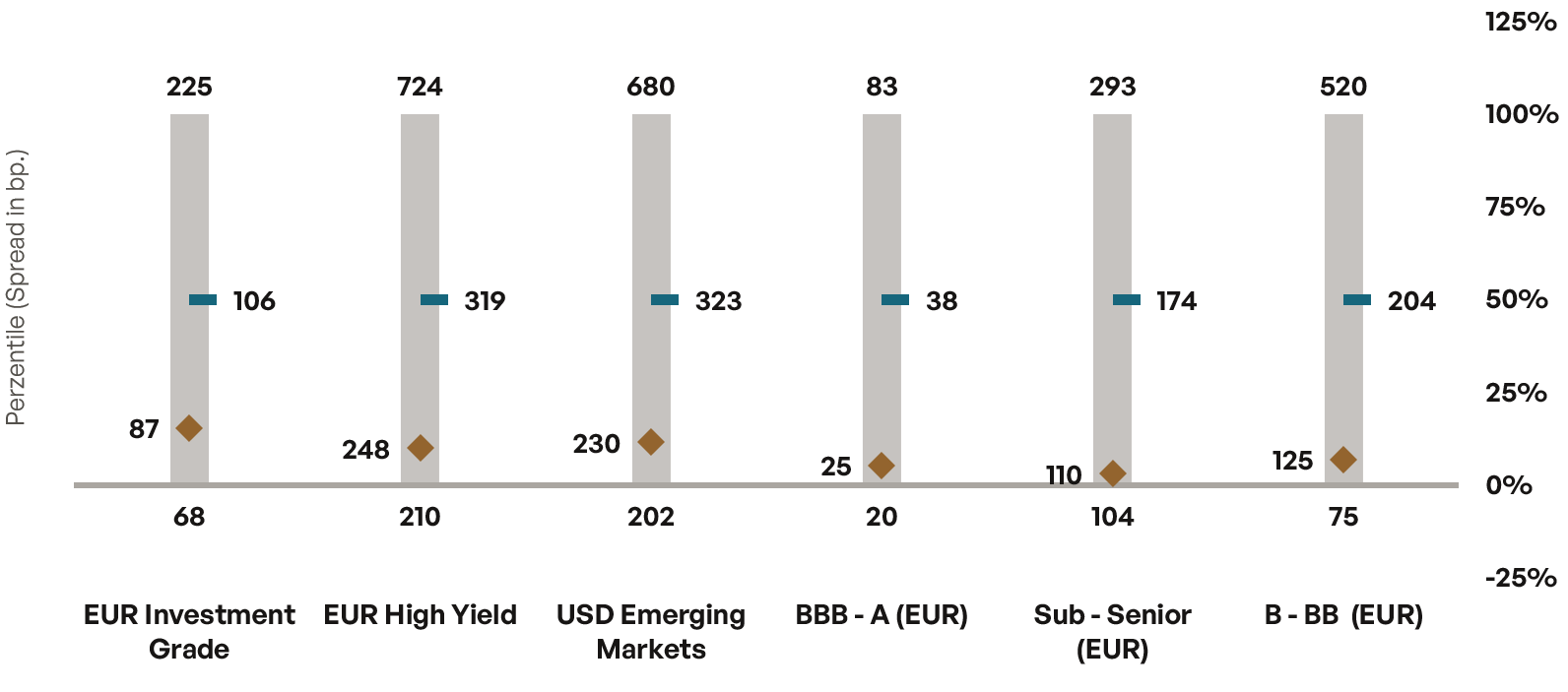
OAS on government bonds, Source: Bloomberg, HAGIM, EUR Investment Grade (LECFTREU), EUR High Yield (H23969EU), USD Emerging Market (H29190EU), BBB –
A (EUR) (own calculation), Sub-Senior (EUR) (own calculation), B–BB (EUR) (own calculation); Period: December 31, 2013, through June 30, 2025.
5. Outlook: Opportunities and Risks
Opportunities
- Geschäftsmodelle mit geringer Nachfrageelastizität und hoher Preissetzungsmacht
- Structural winners that benefit, among other things, from the energy transition
- Issuers with low credit ratings but < 1 >a solid balance sheet and limited refinancing needs
Risks
- Chemical Sector: Structural and Cyclical Challenges Continue to Weigh Heavily
- Companies with unhedged foreign exchange risks, particularly in emerging markets
- Defensive sectors with high debt and a rising interest burden
In an increasingly challenging and structurally changing market environment, we see specific opportunities primarily in business models with a non-cyclical nature. Sectors such as consumer staples, healthcare, and leisure services are characterized by stable cash flows, low demand elasticity, and strong pricing power—attributes that offer valuable resilience during volatile periods and contribute to the stability of portfolio returns.
In the commodities and cyclical industries segment, we selectively focus on structural winners of the transition. We find bonds issued by companies with robust balance sheets and a clear strategic focus on the energy transition particularly attractive—such as copper producers that stand to benefit from the expansion of electric infrastructure.
We also see attractive prospects for issuers in the infrastructure and regulatory sectors—particularly energy grid operators, which generate predictable cash flows through government-supported investment programs.
By contrast, we are cautious about companies that are facing a sharp increase in capital expenditures due to regulatory changes without receiving adequate compensation for the associated risk.
We place particular emphasis on refinancing capacity—especially in the high-yield segment. In this segment, we prefer issuers with conservative debt ratios, a stable liquidity base, and reliable access to capital markets. In an environment of rising financing costs, the wheat is separated from the chaff.
We continue to view the chemical sector with skepticism, as it is suffering from weak fundamentals and unfavorable industry trends. Despite an increase in risk premiums in some cases, the challenges have not yet been fully reflected in the balance sheets and cash flows of many issuers.
In emerging markets, we avoid issuers with significant currency risk and no hedging. Our focus is clearly on companies from Central and Eastern Europe with euro-denominated bonds.
Finally, we remain vigilant even toward supposedly defensive sectors—particularly where high debt levels coincide with a persistently higher interest rate environment< 2 >. European telecommunications companies are a case in point: Despite stable business models, their capital structures harbor significant risks that are not fully reflected in adequate risk premiums across the board.
Risks
Price losses due to increases in yields and/or higher risk premiums are possible. A total loss cannot be ruled out either.
Past performance is not an indication of future results, nor can future performance be guaranteed.
Disclaimer
This marketing communication within the meaning of the German Securities Trading Act
(Wertpapierhandelsgesetz) is provided for information purposes only and should not be construed
as personal investment advice or a recommendation or solicitation to buy, sell or hold
any financial instrument or to adopt any investment strategy. The opinions and statements
contained in this document reflect the current assessment on the date of publication. This information does not constitute a complete analysis of all material facts relating to any country,
region or market. This is not to be considered as financial analysis.
If statements are made about market developments, returns, price gains or other asset
growth as well as risk ratios, these merely constitute forecasts for whose occurrence we assume
no liability. Past performance, simulations or forecasts in particular are not a reliable
indicator of future performance. Assets can go up as well as down. All information has been carefully compiled; partly with recourse to information from third parties.Individual details may prove to be no longer or no longer fully accurate, in particular as a result of the passage of time, changes in the law, current developments on the markets, possibly at short notice, and may change at any time without prior notice. Therefore, no guarantee is given that all the information is correct, complete and up to date.
Please inform yourself independently about all costs relevant to you. Maintaining a custody
account may incur costs; ongoing bank charges may also be incurred. Transaction costs depend
on the asset class: For government bonds and collateralised bonds such as mortgage
bonds, they average around 0.02 percent, for corporate bonds 0.085 percent. For less liquid
bonds, the transaction costs can also be significantly higher than 0.25 per cent. It should also
be noted that transaction costs can temporarily be significantly higher during periods of market
stress. For all products sold by HAGIM, all relevant cost information is made available
prior to purchase.
The information is based on our assessment of the current legal and tax situation. If tax or
legal matters are affected, these should be discussed by the addressee with their tax advisor
or lawyer. Investments in financial instruments are associated with both opportunities and
risks. The handling of conflicts of interest at HAGIM is published online in the legal notice on
https://www.ha-gim.com/en/legal-information. The information contained in this document
is intended for professional clients and eligible counterparties only. This information document
is not directed at US citizens or permanent residents, nor to legal entities domiciled in
the USA, nor may it be distributed in the US.