



Steffen Briel
Senior Portfolio Manager Multi Asset Credit; Investment Grade
Portfolio Management Credit
German automakers have not yet been able to stabilize their profitability. For now, most are offsetting rising business risks with robust balance sheets—but they must use this time to make structural adjustments. The automotive sector is thus increasingly becoming a credit story: cash flow, balance sheet quality, and market access are coming to the fore. In our view, the risk premiums are attractive only at first glance. We therefore remain underweight and selective.
Same Problems—Same Causes
“The latest news from the automotive industry is alarming.” That was the message in our Credit Pulse report, “Automotive Sector: Challenging Times, ” published in October 2024. At that time, leading OEMs—particularly those based in Germany—had been forced to revise their forecasts for the fiscal year downward.
Two years later, a sense of déjà vu sets in, because the causes are the same: a weak Chinese economy, excessive costs, and new competition. On top of that, U.S. tariffs have been in place since 2025.
Unlike in 2024, when there was still talk of a return to normalcy following the record profits of the post-pandemic years, German OEMs have so far failed to stabilize their profitability. From a lender’s perspective, however, focusing solely on profitability is not enough: In some cases, profitability is weighed down by non-cash impairments—a consequence of the restructuring programs that have been implemented and announced. Furthermore, thanks to their robust financial services divisions, most manufacturers continue to have positive net liquidity and maintain consistently high liquidity reserves.
OEM Profitability
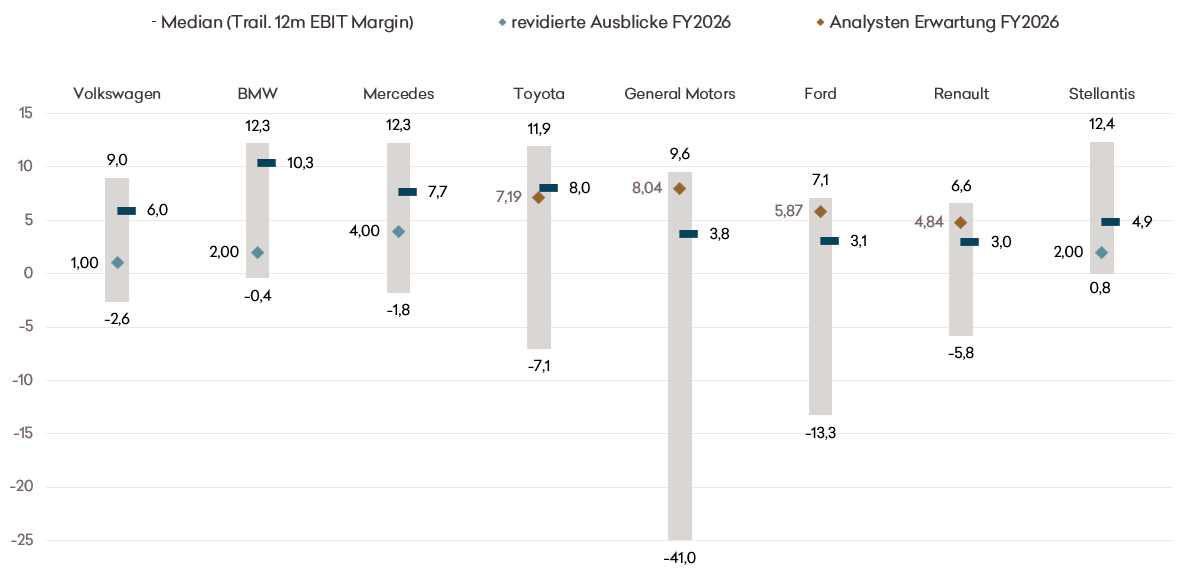
Source: Bloomberg, trailing 12-month EBIT margin, company data, own presentation, period: 2009 through June 30, 2026.
From Earnings Growth to a Credit Story
However, balance sheets—which remain solid in most cases—are coming under pressure due to persistently weak operating performance and the industry’s long-term structural challenges. In our view, regulation, competition, and technological change are significantly increasing business risk in the automotive sector. For now, most manufacturers can still offset this risk with their strong balance sheets. However, OEMs should use the leeway this provides to make the necessary adjustments rather than resting on their laurels. Without structural improvements to their competitive position, operating performance will increasingly result in weaker balance sheets and, consequently, lower credit quality.
As a result, the automotive sector is increasingly becoming a credit story: rather than earnings growth and opportunities, cash flow and balance sheet quality are taking center stage. Symbolically, Volkswagen was removed from the Euro Stoxx 50 on September 21, 2026.
Automotive Sector: Risk Premiums Are Attractive Only at First Glance
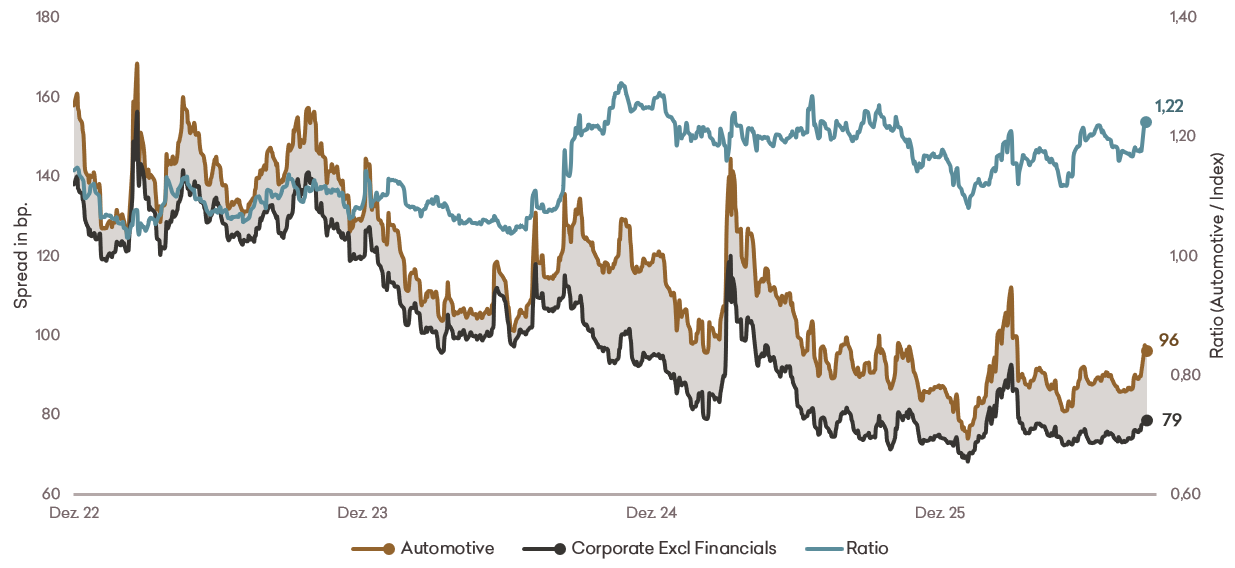
Source: Bloomberg, Automotive (Bloomberg Euro-Aggregate Automotive Index), Industrial BBB (Bloomberg Euro-Aggregate: Industrials Baa Index), own calculations; as of September 18, 2026.
Currently, the spread of the Automotive Index is about 15 basis points above that of the Corporate Non-Financials Index. In the current environment of historically tight spreads, this level appears attractive. A closer look, however, reveals that the risk premium relative to the overall market has hardly changed over the past two years; in absolute terms, it has settled at a higher level since 2024. Furthermore, this analysis overlooks the increasing deterioration in credit quality within the sector. Given the ongoing refinancing needs and the negative operating trend, we remain underweight in the sector and are selectively focusing on individual OEMs.
Risks
Price losses due to increases in yields and/or higher risk premiums are possible. A total loss cannot be ruled out either.
Past performance is not an indication of future results, nor can future performance be guaranteed.
Disclaimer
This marketing communication within the meaning of the German Securities Trading Act
(Wertpapierhandelsgesetz) is provided for information purposes only and should not be construed
as personal investment advice or a recommendation or solicitation to buy, sell or hold
any financial instrument or to adopt any investment strategy. The opinions and statements
contained in this document reflect the current assessment on the date of publication. This information does not constitute a complete analysis of all material facts relating to any country,
region or market. This is not to be considered as financial analysis.
If statements are made about market developments, returns, price gains or other asset
growth as well as risk ratios, these merely constitute forecasts for whose occurrence we assume
no liability. Past performance, simulations or forecasts in particular are not a reliable
indicator of future performance. Assets can go up as well as down. All information has been carefully compiled; partly with recourse to information from third parties.Individual details may prove to be no longer or no longer fully accurate, in particular as a result of the passage of time, changes in the law, current developments on the markets, possibly at short notice, and may change at any time without prior notice. Therefore, no guarantee is given that all the information is correct, complete and up to date.
Please inform yourself independently about all costs relevant to you. Maintaining a custody
account may incur costs; ongoing bank charges may also be incurred. Transaction costs depend
on the asset class: For government bonds and collateralised bonds such as mortgage
bonds, they average around 0.02 percent, for corporate bonds 0.085 percent. For less liquid
bonds, the transaction costs can also be significantly higher than 0.25 per cent. It should also
be noted that transaction costs can temporarily be significantly higher during periods of market
stress. For all products sold by HAGIM, all relevant cost information is made available
prior to purchase.
The information is based on our assessment of the current legal and tax situation. If tax or
legal matters are affected, these should be discussed by the addressee with their tax advisor
or lawyer. Investments in financial instruments are associated with both opportunities and
risks. The handling of conflicts of interest at HAGIM is published online in the legal notice on
https://www.ha-gim.com/en/legal-information. The information contained in this document
is intended for professional clients and eligible counterparties only. This information document
is not directed at US citizens or permanent residents, nor to legal entities domiciled in
the USA, nor may it be distributed in the US.