


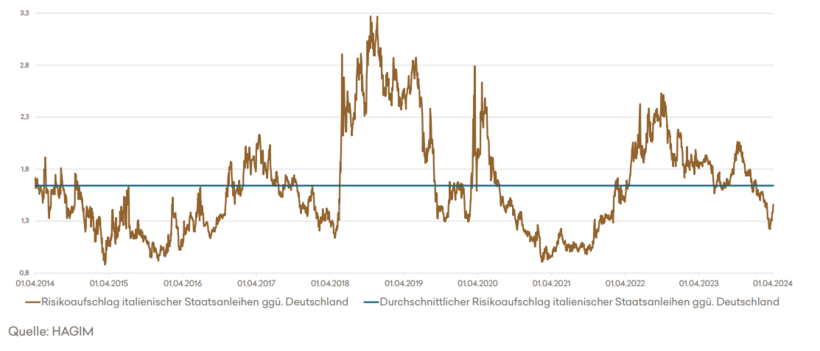
The positive performance of the Italian economy, driven by changes in macroeconomic conditions, is increasingly reflected in the capital markets and is being recognized by investors. Looking at the risk premiums for Italian government bonds compared to German government bonds, it is notable that they currently stand at less than 1.5 percentage points—below the historical average for the past 10 years. Consequently, this contributes to more favorable financing terms for Italian companies.
A look at activity in the private debt market reveals that Italy remains underrepresented in European private debt portfolios relative to its share of GDP. Also noteworthy is the already emerging trend of significantly faster market growth in Italy compared to the overall European private debt market (EU including the UK) as well as the traditionally large private debt markets of the UK and France. This, coupled with a streamlined Italian banking system and the onset of disintermediation, is contributing to an improved investment environment for alternative lenders such as private debt funds.
Economic Recovery in Italy
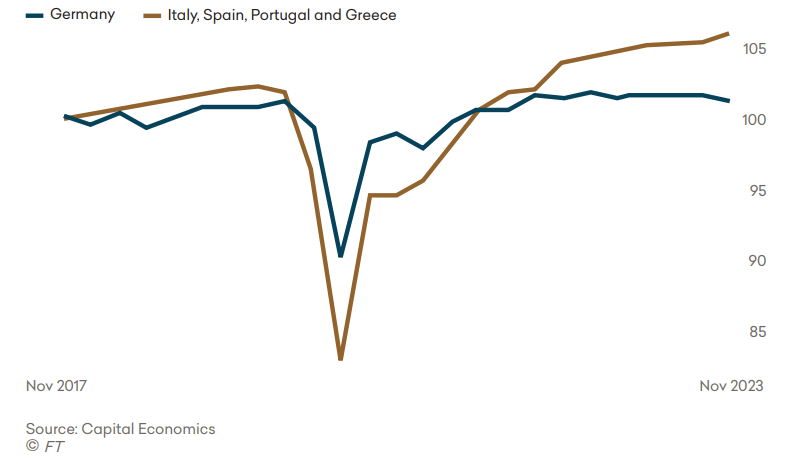
The situation currently looks different, particularly in Germany and other Northern European countries such as Austria or the Netherlands. It is therefore hardly surprising that Italy, Spain, Portugal, and Greece together were able to increase their gross domestic product by €200 billion over six years, while Germany recorded GDP growth of only €85 billion during the same period, as shown by an analysis by Capital Economics for the Financial Times.
Southern European Economies Have Been Outperforming Germany
(Gross Domestic Product Index [Q4]
Recipients of EU Funds
In addition, countries such as Italy and Greece are benefiting greatly from government investment through increased use of ECB funds. The EU Recovery Fund, with a total volume of €800 billion, also plays a role here; its mix of grants and low-interest loans—in exchange for growth-promoting structural reforms—benefits Southern European countries in particular. Italy and Spain are the largest recipients.
Catching Up in Competitiveness
Low Financing Costs
The spread between 10-year German and Italian government bonds—which reflects the risk premium on Italian government bonds—currently stands at less than 1.5 percentage points, which is below the historical average for the past 10 years. In addition to the Italian government, Italian companies—whose financing costs consist of the risk-free rate and a risk premium—are also benefiting from more favorable financing terms.
Yield Spread on 10-Year Government Bonds
Opportunities in the Private Debt Market
Opportunities in the Private Debt Market

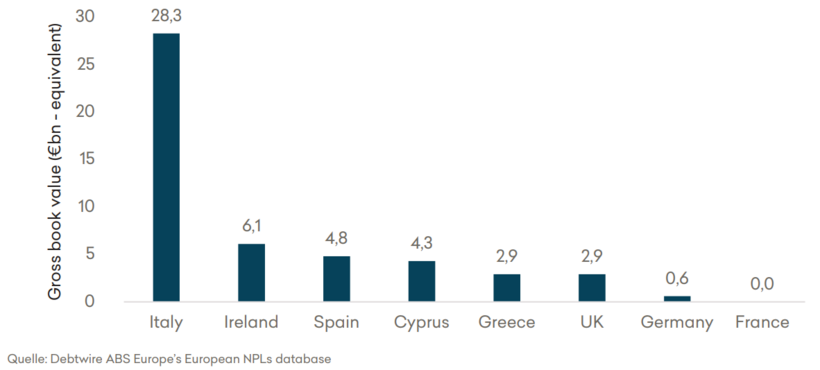
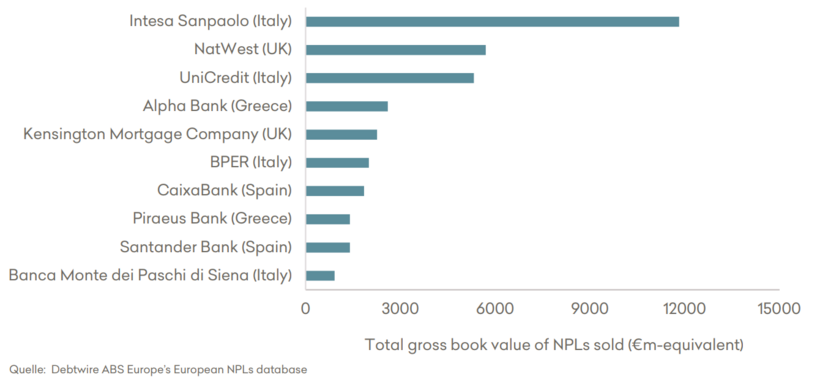
This is mainly due to the fact that the Italian banking system is highly fragmented and has been heavily focused on reducing NPLs (non-performing loans).
European NPLs: Total Deals Signed in 2022 by Country
European NPL Top Sellers in 2022 (€m Equivalent)
In the first 9 months of 2023, the Italian private debt market presented a different picture than in 2021 and 2022. Italy recorded market growth in assets under management in the Direct Lending & Mezzanine/Subordinated segment of just under 63%.
This suggests that the changed conditions in the Italian banking system are already taking effect (advanced reduction of NPLs as well as incipient disintermediation, which enables alternative lenders—such as private debt funds—in particular to extend loans without the involvement of credit institutions).
As a result, the Italian private debt market recorded significantly faster growth than the European private debt market (EU including the UK) and the traditionally large private debt markets of the UK and France. Given the currently low weighting of Italian debtors in European private debt portfolios, this development could help create broader and better-diversified portfolios in the future.

On the other hand, Italy’s underrepresentation in European private debt portfolios relative to GDP, the expected and already emerging significantly faster market growth in Italy, a streamlined Italian banking system, and the onset of disintermediation are creating advantages for alternative lenders such as private debt funds.
Disclaimer
This marketing communication, as defined by the Securities Trading Act, is provided solely for informational purposes and should not be construed as personal investment advice, a recommendation, or a solicitation to buy, sell, or hold a financial instrument, or to adopt an investment strategy.
The opinions and statements contained in this document reflect the current assessment as of the date of publication. The information provided does not constitute a complete analysis of all material facts relating to a country, region, or market.
Any statements regarding market developments, returns, price gains, or other capital appreciation, as well as risk metrics, are merely forecasts for which we assume no liability. In particular, past performance, simulations, or forecasts are not a reliable indicator of future performance. Asset values may rise or fall.
All information has been carefully compiled, in some cases based on information from third parties. Individual pieces of information may, in particular due to the passage of time, changes in the law, or current market developments, prove to be no longer accurate—or no longer fully accurate—even at short notice, and may change at any time without prior notice.
Therefore, no warranty is provided as to the accuracy, completeness, or timeliness of any information. The information is based on our assessment of the current legal and tax situation. To the extent that tax or legal matters are addressed, the recipient should discuss these with their tax advisor or attorney.
Investments in financial instruments involve both opportunities and risks. HAGIM’s policy on handling conflicts of interest is published online at www.ha-gim.com/rechtliche-hinweiserechtliche-hinweise.
The information contained herein is intended solely for professional clients or eligible counterparties. This information document is not intended for U.S. citizens or persons permanently residing in the United States, nor may it be distributed in the United States.