


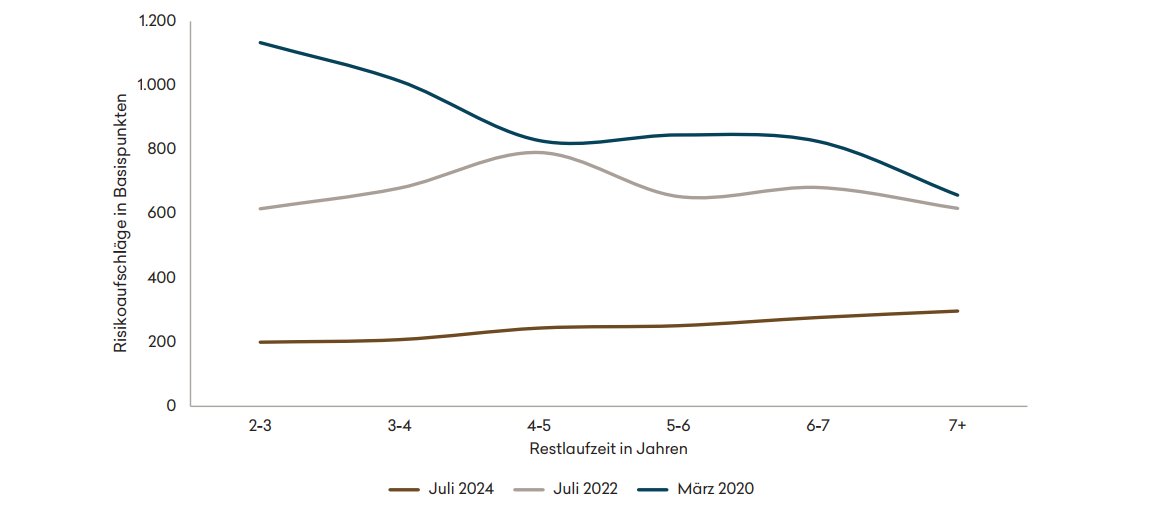
Normally, longer-term corporate bonds command higher risk premiums as compensation for the increased uncertainty. In times of stress or crisis, however, this can temporarily reverse, and shorter-term bonds may exhibit comparable or even higher spreads!
Upward-Sloping Spread Curves
This is because a bond’s risk premium is intended to compensate the investor for the default risk over the bond’s entire term. Therefore, a potential deterioration in credit quality over time must also be taken into account. However, the further into the future one tries to forecast the development of credit quality, the more difficult and uncertain the result becomes.
In the short term, a company’s credit quality should not change significantly, and the probability of default can be assessed relatively well (lower debt repayments, good liquidity, an established market position, and existing customer relationships).
Over a 5- or 10-year horizon, however, a great deal can happen (new competitors, regulatory changes, shifts in customer preferences, etc.), and the question of repayment becomes significantly more difficult to answer. To account for this increasing uncertainty regarding bond repayment, investors generally expect a higher risk premium for longer maturities from the same issuer.
This phenomenon can be observed in the spread curves of individual issuers, as well as in aggregate at the index level. For example, the current spread curve of the European high-yield market shows a slightly positive slope (see figure).
Flat and Inverted Spread Curves
This occurs when the short-term default risk is viewed as particularly high due to acute problems or market disruptions. Thus, in the case of an inverted spread curve, investors expect a high short-term default risk, but anticipate a subsequent decline to more normal levels (provided the company remains in business).
For the overall market, this phenomenon can be observed during an external shock or major economic disruptions (e.g., the 2008–2009 financial crisis, the 2020 COVID-19 pandemic, or the 2022 rise in interest rates).
Risk Premiums by Maturity Band
Certain Default
In this case, bonds of all maturities will trade at the same price level—the level of expected recovery. However, due to the shorter duration of short-term bonds, they will mathematically exhibit a significantly higher spread than longer-term bonds trading at the same price.
Risk Premiums by Maturity Band (Issuer with Very High Default Risk)

Opportunities Presented by an Inverted Spread Curve?
There is no simple, blanket answer to this question. If the inverted spread curve persists for a longer period—which, however, is rather rare—a short-term bond with a higher yield can, of course, deliver better performance.
However, if market stress subsides and the spread curve normalizes (no longer inverted and at a generally lower level), longer-term bonds may have an advantage due to their higher duration, even if they experience a smaller overall narrowing of the spread than short-term bonds.
Roll-Down
For example, if one invests in a bond issued by an issuer whose credit profile remains relatively stable, the bond’s risk premium should decrease as its remaining maturity declines. This allows investors to generate not only yield but also price gains from the narrowing of the spread.
Conclusion:
These various patterns offer experienced investors the opportunity to generate attractive returns. For this reason, it is advisable to entrust investments in corporate bonds in general—and high-yield bonds in particular—to a proven fixed-income credit specialist.
At HAGIM, we consider ourselves well-equipped to meet such challenges thanks to our investment philosophy, which is based on in-depth fundamental credit analysis.
Risks
Price losses due to increases in yields and/or higher risk premiums are possible. A total loss cannot be ruled out either. Past performance is not indicative of future results, nor can future performance be guaranteed.
Disclaimer
This marketing communication, as defined by the Securities Trading Act, is provided solely for informational purposes and should not be construed as personal investment advice, a recommendation, or a solicitation to buy, sell, or hold a financial instrument, or to adopt an investment strategy.
The opinions and statements contained in this document reflect the current assessment as of the date of publication. The information provided does not constitute a complete analysis of all material facts relating to a country, region, or market.
Any statements regarding market trends, returns, price gains, or other increases in asset value, as well as risk metrics, are merely forecasts, and we assume no liability for their realization. In particular, past performance, simulations, or forecasts are not a reliable indicator of future performance. Asset values may rise or fall. All information has been carefully compiled, in some cases based on information from third parties. Individual pieces of information may, in particular due to the passage of time, changes in the law, or current market developments, prove to be no longer accurate—or no longer fully accurate—even at short notice, and are subject to change at any time without prior notice. Therefore, no warranty is provided as to the accuracy, completeness, or timeliness of any information. The information is based on our assessment of the current legal and tax situation. To the extent that tax or legal matters are addressed, the recipient should discuss these with their tax advisor or attorney. Investments in financial instruments involve both opportunities and risks. HAGIM’s policy on handling conflicts of interest is published online at www.ha-gim.com/rechtliche-hinweise. The information contained herein is intended solely for professional clients or eligible counterparties. This information document is not intended for U.S. citizens or persons permanently residing in the United States, nor may it be distributed in the United States.