



Thomas Rentsch
CFA, Senior High-Yield Portfolio Manager
The high-yield market is shrinking… and that’s a good thing!
Since peaking in early 2022, the European high-yield bond market has shrunk significantly. Does the market have a problem?
Our expert and Senior Portfolio Manager Thomas Rentsch believes that so-called “Rising Stars” are responsible for the market’s decline and answers the question with a resounding “no.” Read here to find out how our expert arrived at this conclusion.
Does the Market Have a Problem?
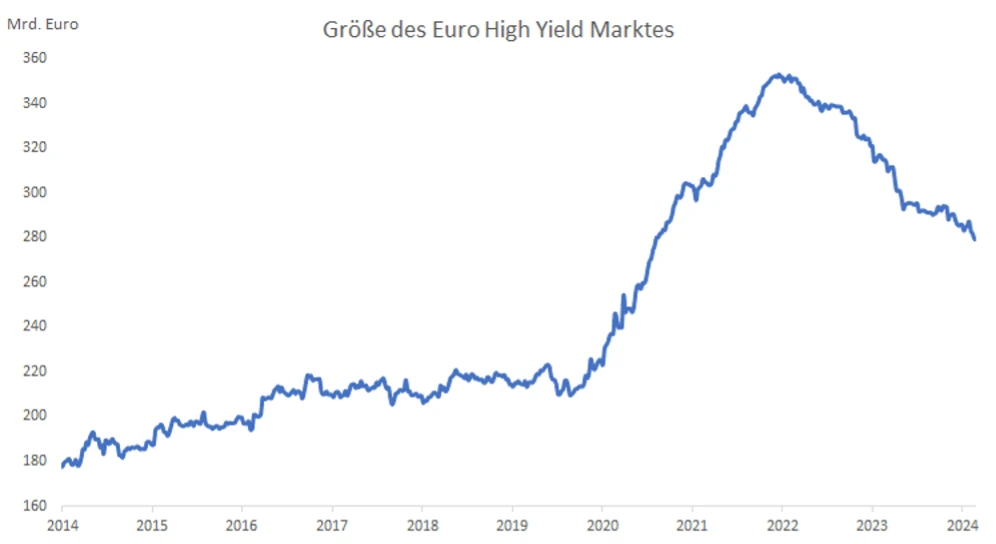
Source: Bloomberg (Bloomberg High Yield (Euro) ex Financial Index), high-yield bonds denominated in euros, including CCC-rated bonds and excluding financial sector bonds; aggregate outstanding nominal bond volume; as of February 21, 2024.
Another group among the Rising Stars consisted of companies that had lost their investment-grade ratings in 2020 amid the COVID-19 pandemic. These companies had improved their credit quality again over the past two years and managed to make the leap back into the “premier league” (e.g., Ford with €5.0 billion or Lufthansa with €4.0 billion).
Refinancing outside the Euro High Yield market—such as USD bonds or bank loans, which in some cases offered more attractive terms over the past two years—accounted for a smaller portion of the market decline.
At the same time, there have been virtually no “Fallen Angels”—that is, downgrades from investment grade to high yield—since the beginning of 2022.
Defaults were also very low and had no significant impact on the size of the market.
Conclusion
The decline in the size of the high-yield market should not be interpreted negatively, as it is the result of improving credit quality and, in part, a reversal of the strong growth seen during the COVID-19 pandemic (Fallen Angels in 2020–2021).
Furthermore, the decline in market size has no impact on issuers’ ability to refinance, as evidenced by the significant increase in new issuance activity in recent months.
In fact, this trend is likely to provide sustained support for the high-yield market, as continued strong demand meets lower supply.
Risks
Past performance is not indicative of future results, nor can future performance be guaranteed.
Disclaimer
The opinions and statements contained in this document reflect the current assessment as of the date of publication. The information provided does not constitute a complete analysis of all material facts relating to a country, region, or market.
Where statements are made regarding market developments, returns, price gains, or other increases in asset value, as well as risk metrics, these are merely forecasts, and we assume no liability for their realization. In particular, past performance, simulations, or forecasts are not a reliable indicator of future performance. Asset values can rise as well as fall.
All information has been carefully compiled, in some cases drawing on information from third parties. Individual pieces of information may, in particular due to the passage of time, changes in the law, or current market developments, prove to be no longer accurate—or no longer fully accurate—even at short notice, and may change at any time without prior notice.
Therefore, no guarantee is provided as to the accuracy, completeness, or timeliness of any information. The information is based on our assessment of the current legal and tax situation. To the extent that tax or legal issues are addressed, the recipient should discuss these with their tax advisor or attorney.
Investments in financial instruments involve both opportunities and risks. HAGIM’s policy on handling conflicts of interest is published online at: www.ha-gim.com/rechtliche-hinweise. The information contained herein is intended solely for professional clients or eligible counterparties. This information document is not intended for U.S. citizens, persons permanently residing in the United States, or legal entities domiciled in the United States, nor may it be distributed in the United States.